Upon the high granitic heights of the Velay, Berbezit emerges as a sparse collection of stone dwellings nearly swallowed by a vast ocean of spruce and pine. At an elevation touching a thousand meters, the air carries a sharp, resinous clarity, typical of the Haut-Velay plateau. This is a landscape defined by its profound silence and the verticality of its timber, where the sunlight struggles to pierce a forest canopy that claims over eighty percent of the land. Wandering the narrow lanes reveals a settlement that has retreated into the quiet, slow-breathing rhythms of the woodland, offering a stark, meditative contrast to the more manicured valleys located further north.
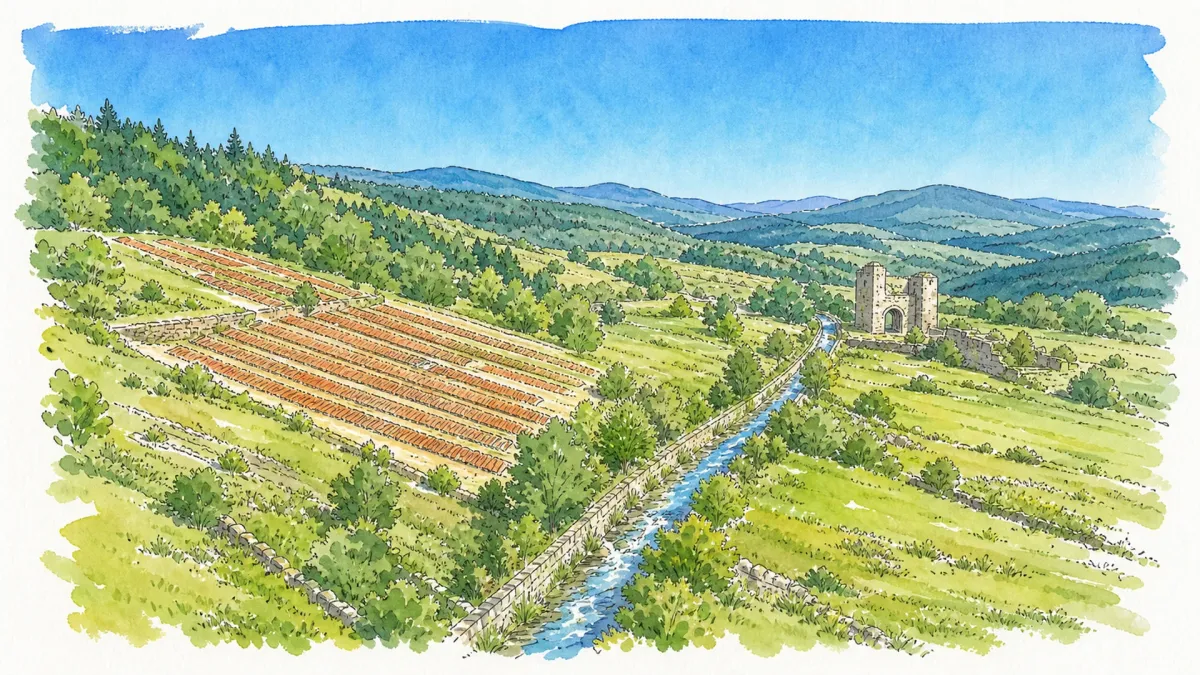
The local topography still bears the faint, moss-covered scars of a more industrious era, specifically where the Berbezit stream was once harnessed by a man-made dam and reservoir. Today, the skeletal remains of three watermills sit as crumbling stone sentinels, their wheels long since surrendered to the damp earth and encroaching ferns. Before the social upheavals of the late 18th century, this remote outpost served as a center of tactile craft, housing a tile factory that transformed local clay into thousands of architectural elements each year. These vanished chimneys and silent watercourses provide a haunting subtext to an afternoon walk, evoking a time when the plateau hummed with the rhythmic labor of grain-grinding and kiln-firing.
Central to the village’s spiritual and architectural identity is the Church of the Nativity-of-the-Holy-Virgin, a structure that retains the austere dignity of its origins as a private seigneurial chapel for the local castle. Within its cool interior, the transition from its 14th-century expansion to the intricate Gothic choir creates an atmosphere of somber, medieval nobility. The 15th-century sculptures and the refracted light passing through Charles Borie’s stained glass illuminate a sacred space that has watched over the plateau for seven hundred years. It stands as a singular, enduring anchor in a territory of dispersed hamlets, representing the long historical reach of the nearby Abbey of La Chaise-Dieu across these high, lonely lands.
Local profile
At a Glance
- Population
- 45
- Demonym
- —
- Altitude
- 712–1163 m
- Forest
- 81.1%
residents
local residents
lowest to highest
commune coverage
Did You Know?
“Before the French Revolution, this small commune supported a specialized tile factory that produced 4,000 terracotta tiles annually for the region.”
Cultural Heritage
A quiet village with authentic Auvergne charm.
Recent Wildlife & Flora Log
Nature observations recorded within 5km of Berbezit.
Peacock
Marsh Valerian
Yellow Gentian
Green Carpet
Striped Hawk-moth
Peach Blossom
Chrysotoxum lessonae Giglio-Tos, 1890
Three-Humped Prominent
Purple Cloud
Green Shieldbug
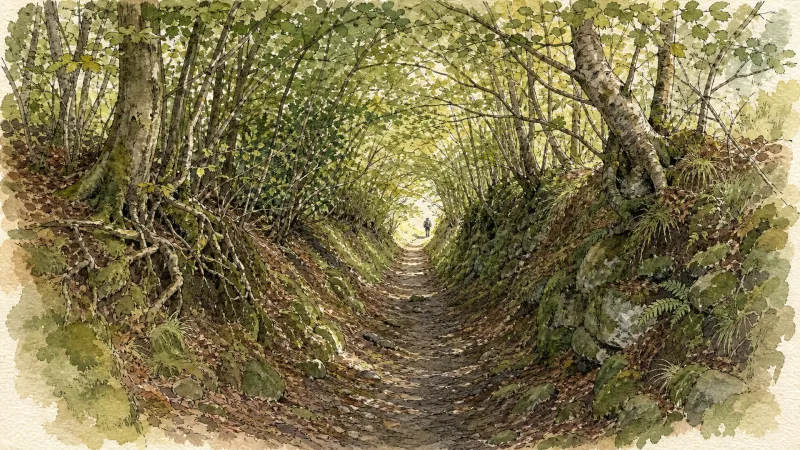
Trails around Berbezit
Discover physical challenges and natural beauty in the immediate vicinity.
Explore Nearby
Complement your visit to Berbezit by exploring these neighboring villages.
Cistrières
A high-altitude sanctuary of granite and forest on the Velay plateau, offering a quiet encounter with 12th-century Romanesque masonry.
Collat
A high-altitude sanctuary of silence and granite, where the dense forests of the Haute-Loire meet the ancient social echoes of the Massif Central.
Connangles
A high-altitude sanctuary where ancient monastic history meets the dense, whispering forests of the granite plateau.
Montclard
A deep-valley sanctuary where silence is held by a comb-style bell tower and the skeletal remains of medieval power.
Saint-Didier-sur-Doulon
A vertical landscape of dense forests and feudal stone, where the Doulon river flows beneath the gaze of the monumental Château de Servières.
Saint-Pal-de-Senouire
A high-altitude sanctuary where the Senouire river cuts through ancient granite plateaus and dense fir forests.
Saint-Préjet-Armandon
A high-altitude sanctuary of dense forest and medieval history, offering a quiet afternoon of exploration among the rugged textures of the Haute-Loire.
Vals-le-Chastel
A silent sentinel of stone and timber, this ancient feudal site offers a quiet immersion into 15th-century Auvergne through its fortified chapel and haunting medieval frescoes.