Illustration in progress
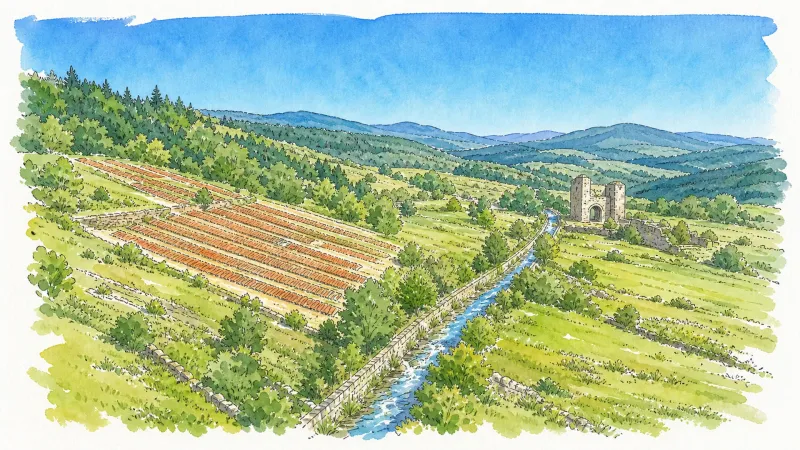
The landscape of Saint-Pal-de-Senouire is defined by a profound arboreal density, where towering firs colonize the steep, granitic inclines of the Haut-Velay massif. At these altitudes, which reach over 1,200 meters, the Senouire river performs a rhythmic carving of the terrain, creating a topography characterized by sharp contrasts between high, wind-swept ridges and cool, shadowed valleys. The environment exerts a tactile presence; the scent of damp resin hangs heavy in the air, and the silence of the woods is periodically punctuated by the cold, insistent rush of the water over stone. It is a location for those who appreciate the raw, unvarnished textures of the Auvergne highlands, offering a spatial rhythm that encourages a slow, deliberate pace of observation.
Centrally positioned within this sparsely populated territory is the Église Saint-Paul, a Romanesque structure of muscular stone and austere lines. This sanctuary, protected as a historical monument since 1969, embodies the architectural resilience required to withstand the harsh winters of the mountain margins. The masonry, weathered by centuries of alpine exposure, guards a quiet interior where light filters through narrow apertures to illuminate ancient arches. The church’s silhouette, anchored by a distinctive bell tower, serves as a navigational beacon for travelers wandering the surrounding hamlets, standing as a testament to the enduring spiritual and communal heart of the region.
The identity of the commune is further revealed through its shifting history and the symbolic language of its heraldry. Having navigated the turbulent waters of the French Revolution—during which it was briefly renamed Saint-Pol-de-Murs and later Pal-Sénouire—the village eventually reclaimed its full title in 1946. This heritage of adaptation is immortalized in the local blazon, which depicts the silver narcissus flowers that populate the upland meadows and the trout that navigate the river’s golden ripples. To spend an afternoon traversing the paths of Saint-Pal-de-Senouire is to engage with a narrative of independence and isolation, where the legacy of the old parish persists through the integrity of its granite walls and the deep, hushed corridors of the surrounding forest.
Local profile
At a Glance
- Population
- 108
- Demonym
- —
- Altitude
- 789–1204 m
- Forest
- 68.7%
residents
local residents
lowest to highest
commune coverage
Did You Know?
“During the French Revolution, the commune was stripped of its religious name and rebranded as "Pal-Sénouire" to satisfy the secular mandates of the National Convention.”
Cultural Heritage
Protected historic monuments in Saint-Pal-de-Senouire
Eglise Saint-Paul
Sur la route de la Chaise-Dieu à Paulhaguet
Recent Wildlife & Flora Log
Nature observations recorded within 5km of Saint-Pal-de-Senouire.
Peacock
Marsh Valerian
Yellow Gentian
Green Carpet
Striped Hawk-moth
Peach Blossom
Chrysotoxum lessonae Giglio-Tos, 1890
Three-Humped Prominent
Purple Cloud
Green Shieldbug
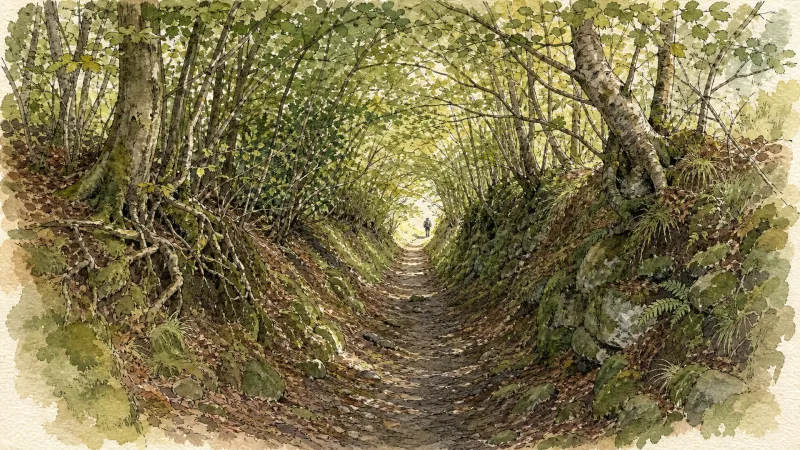
Trails around Saint-Pal-de-Senouire
Discover physical challenges and natural beauty in the immediate vicinity.
Explore Nearby
Complement your visit to Saint-Pal-de-Senouire by exploring these neighboring villages.
Berbezit
A high-altitude sanctuary on the granitic plateau of the Velay, where ancient mill ruins and a former seigneurial chapel are enveloped by a dense, resinous forest.
Collat
A high-altitude sanctuary of silence and granite, where the dense forests of the Haute-Loire meet the ancient social echoes of the Massif Central.
Connangles
A high-altitude sanctuary where ancient monastic history meets the dense, whispering forests of the granite plateau.
Josat
A high-altitude sanctuary of granite and timber, where the silence of the forest meets the ancient echoes of the Tourette lineage.
La Chapelle-Bertin
A high-altitude sanctuary on the granitic plateaus of the Velay, where the Senouire river carves through ancient forests and XIIth-century stone.
Monlet
An evocative ascent into the High Velay where Gallo-Roman remnants meet the stoic silence of granite plateaus and ancient forests.
Montclard
A deep-valley sanctuary where silence is held by a comb-style bell tower and the skeletal remains of medieval power.
Sembadel
A high-altitude silvan enclave where railway history meets the nascent springs of the Senouire river amidst dense resinous forests.