Illustration in progress
The ascent toward the high plateaus of the Haut-Velay reveals a landscape defined by the relentless incision of the Senouire river through ancient granitic bedrock. At an altitude peaking over eleven hundred meters, the atmosphere carries a sharp, resinous edge, a byproduct of the dense woodland that blankets more than seventy percent of the territory. The topography here is one of deep, shadowed valleys and exposed ridges, where the rhythm of the natural world remains undisturbed by the intrusions of modern urbanization. It is a destination defined by its silence and the tactile presence of the elements, offering an encounter with the raw, unyielding character of the Auvergne highlands.
At the heart of this sparsely populated commune stands the Église Saint-Marcellin, a XIIth-century sentinel of Romanesque sobriety. The stone masonry, weathered by centuries of alpine winters, possesses a heavy, grounded beauty that reflects the village’s medieval origins, first documented in 1252 as Ecclesia de Capella. The building’s noble lines and austere vaulted interior provide a sanctuary of stillness, preserving a vernacular architectural language that prioritizes structural permanence over decorative excess. Observing the interplay of light against the rough-hewn granite of the nave provides a profound connection to the historical continuity of the Livradois-Forez.
Beneath the verdant canopy of the Senouire valley lies a subterranean world of significant ecological and industrial history. The “complexe minier de la vallée de la Senouire,” now a protected Natura 2000 site, consists of historical mining galleries that have been reclaimed by the earth and its nocturnal inhabitants. This intersection of human labor and natural resurgence has created one of the region’s most vital habitats for rare bat colonies, adding a layer of hidden complexity to a walk along the riverbanks. As the sun dips below the high ridges, the transition from the sun-drenched plateaus to the cool, emerald depths of the valley floor encapsulates the enduring mystery of this highland terrain.
Local profile
At a Glance
- Population
- 50
- Demonym
- Altitude
- 680–1136 m
- Forest
- 70.4%
residents
local residents
lowest to highest
commune coverage
Did You Know?
“The valley below the village contains a vast network of abandoned mining galleries that now serve as the most significant sanctuary for bat research and conservation in the Haute-Loire.”
Cultural Heritage
Protected historic monuments in La Chapelle-Bertin
Eglise Saint-Marcellin
La Chapelle-Bertin
Recent Wildlife & Flora Log
Nature observations recorded within 5km of La Chapelle-Bertin.
European Rock Bunting
Common Ragwort
Common Sheep Sorrel
Peacock
Crosswort
Golden Cup
Hygrophorus marzuolus (Fr.) Bres.
False Morel
Marsh Valerian
Green Carpet
Explore Nearby
Complement your visit to La Chapelle-Bertin by exploring these neighboring villages.
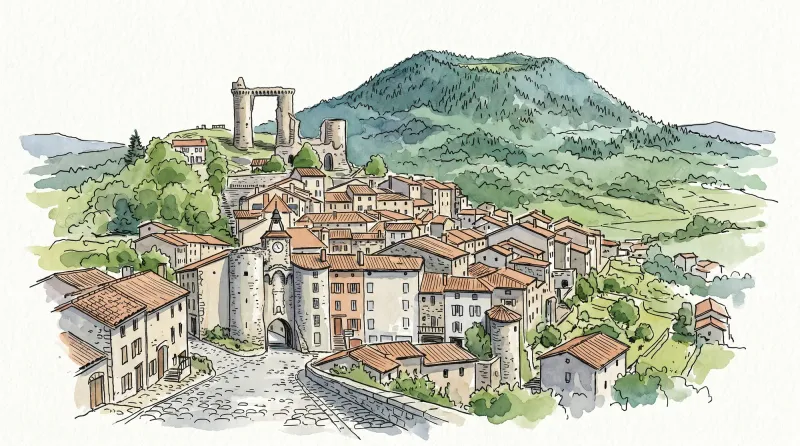
Allègre
A volcanic sentinel defined by the skeletal remains of its feudal fortress and a labyrinth of fifteenth-century noble residences.
Collat
A high-altitude sanctuary of silence and granite, where the dense forests of the Haute-Loire meet the ancient social echoes of the Massif Central.
Jax
A high-altitude sanctuary where Gallic fortifications meet silent forests, offering a contemplative afternoon among ancient stone and panoramic mountain ridges.
Josat
A high-altitude sanctuary of granite and timber, where the silence of the forest meets the ancient echoes of the Tourette lineage.
Monlet
An evocative ascent into the High Velay where Gallo-Roman remnants meet the stoic silence of granite plateaus and ancient forests.
Saint-Pal-de-Senouire
A high-altitude sanctuary where the Senouire river cuts through ancient granite plateaus and dense fir forests.
Sainte-Marguerite
A high-altitude sanctuary of silence, where the Senouire river winds through dense forests and granite-flecked hamlets of the High Forez.
Varennes-Saint-Honorat
A high-altitude sanctuary where ancient woods reclaim the silence of a nearly forgotten hamlet, offering a somber and serene window into the rugged history of the Velay.