Illustration in progress
Varennes-Saint-Honorat exists as a study in arboreal dominance, where the forest claims over eighty-five percent of the rugged terrain. Ascending toward the eleven-hundred-meter peaks of the Velay, the air grows thin and sharp, carrying the scent of pine and damp granite. This is a landscape of transition, perched between the opposing meteorological forces of the northern and southern Massif Central, resulting in a climate that is as temperamentally mountain-bound as it is profoundly quiet. The geography here is not one of gathered streets, but of scattered stone, where the few remaining inhabitants occupy a world defined by the deep green shadows of the Livradois-Forez.
At the heart of this sparse settlement stands the Church of Saint-Denys, a structure whose weathered masonry reflects the stoic resilience required of high-altitude life. The history of the commune is etched into its name, which was stripped of its hagiographic roots during the revolutionary fervor of the late eighteenth century to become Varenne-la-Raison. This brief flirtation with secular Enlightenment did little to alter the fundamental rhythm of the land, which remains anchored in the tactile reality of the Auvergne highlands. A stroll through the open spaces reveals an environment where human influence has receded, leaving behind a serene, almost monastic stillness that invites contemplation of the ancient, slow-moving cycles of the forest.
Beneath the surface of this sylvan tranquility lies a darker narrative thread, one that draws the historically curious to confront the echoes of a notorious nineteenth-century tragedy. In 1896, these woods became the stage for one of the final acts of the serial killer Joseph Vacher, often referred to as the French Ripper, whose presence once cast a long shadow over the pastoral peace of the Haute-Loire. Today, the tension of that era has dissolved into the rustle of leaves and the distant calls of mountain birds, yet the memory of Rosine Rodier lingers as a poignant ghost within the landscape. The contrast between the violent history and the current, absolute silence of the woods provides a compelling layer of gravity for those wandering through this elevated corner of the park.
Local profile
At a Glance
- Population
- 26
- Demonym
- —
- Altitude
- 720–1174 m
- Forest
- 85.6%
residents
local residents
lowest to highest
commune coverage
Did You Know?
“During the French Revolution, the commune renounced its religious namesake to be called Varenne-la-Raison, or "Varenne the Reason."”
Cultural Heritage
A quiet village with authentic Auvergne charm.
Recent Wildlife & Flora Log
Nature observations recorded within 5km of Varennes-Saint-Honorat.
Pulmonaria affinis Jord.
European Rock Bunting
Song Thrush
Bigleaf Periwinkle
Common Ragwort
Common Sheep Sorrel
Helleborus foetidus L.
Teucrium scorodonia L.
Barren Strawberry
Southern Willow-Herb
Explore Nearby
Complement your visit to Varennes-Saint-Honorat by exploring these neighboring villages.
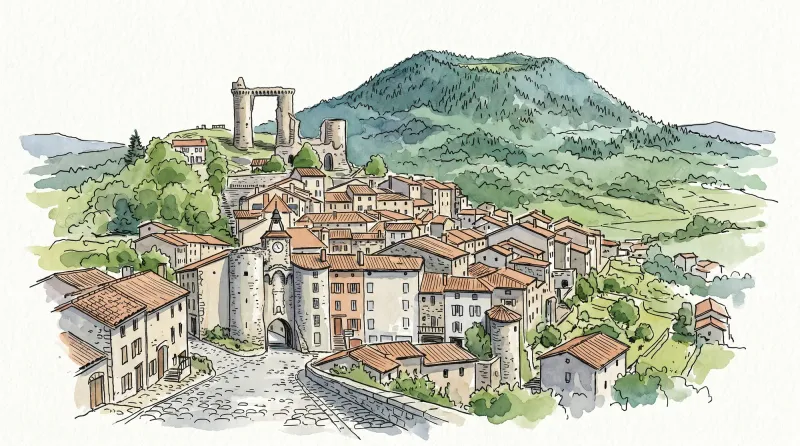
Allègre
A volcanic sentinel defined by the skeletal remains of its feudal fortress and a labyrinth of fifteenth-century noble residences.
Chavaniac-Lafayette
An evocative journey to the ancestral manor of the "Hero of Two Worlds," where Enlightenment ideals are etched into the rugged basalt and granite of the Auvergne highlands.
Jax
A high-altitude sanctuary where Gallic fortifications meet silent forests, offering a contemplative afternoon among ancient stone and panoramic mountain ridges.
Josat
A high-altitude sanctuary of granite and timber, where the silence of the forest meets the ancient echoes of the Tourette lineage.
La Chapelle-Bertin
A high-altitude sanctuary on the granitic plateaus of the Velay, where the Senouire river carves through ancient forests and XIIth-century stone.
Sainte-Eugénie-de-Villeneuve
An elevated enclave of imperial history and forestry where the echoes of a former postal relay meet the austere beauty of the Haute-Loire highlands.
Sainte-Marguerite
A high-altitude sanctuary of silence, where the Senouire river winds through dense forests and granite-flecked hamlets of the High Forez.