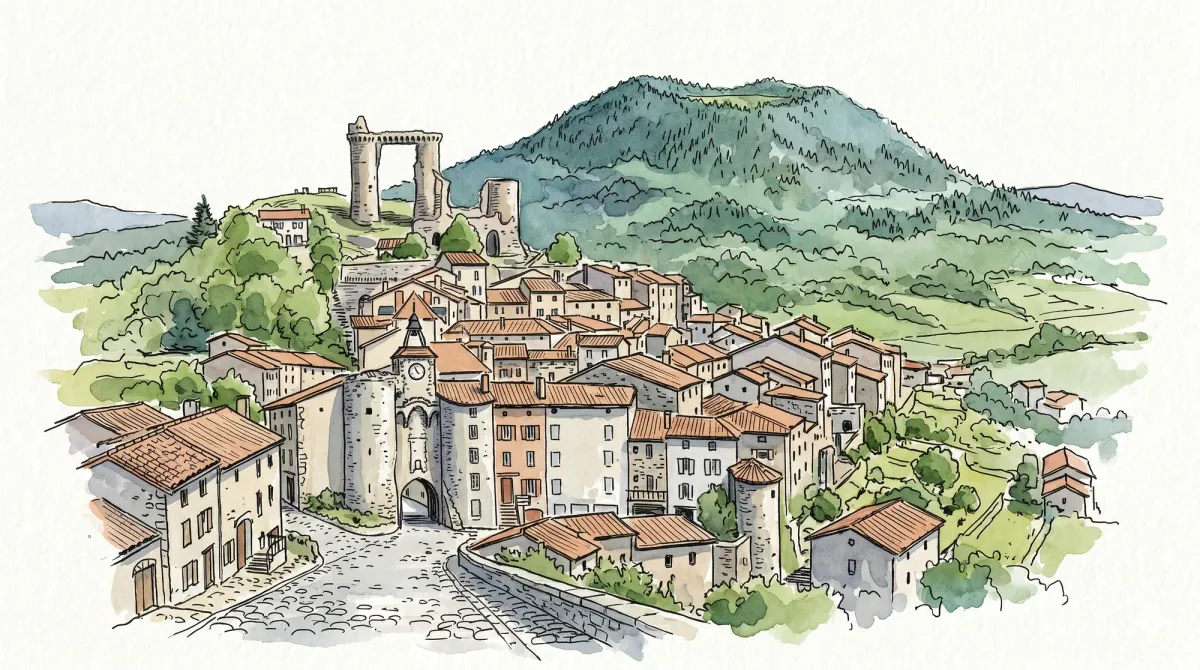
The silhouette of Allègre is dominated by the skeletal defiance of “La Potence,” the fractured remains of a once-mighty fortress that succumbed to a catastrophic fire in 1698. Perched upon the volcanic flank of Mount Baury, the ruins consist of two slender towers linked by a high, precarious cornice, creating a haunting profile that commands the Velay landscape. The masonry here tells a story of obsidian-dark basalt and scorched granite, materials birthed from the five hundred extinct volcanoes that define this high-altitude terrain. Walking among these stones, one feels the weight of a lineage that began with the d’Alegre knights and culminated in a “bastille of candles”—a defensive marvel of twenty-three towers that once repelled the marauding routiers of the Hundred Years’ War.
Descending from the heights of the castle, the town reveals a dense concentration of fifteenth-century civil architecture, where the wealth of the Tourzel marquisate remains etched in stone. The Porte de Monsieur serves as a formidable gateway to this era, retaining its original portcullis grooves and trefoiled machicolations that speak to a time of high-stakes feudal defense. Within the winding streets, the private hotels of the vassal nobility—such as the Hôtel du Chier with its elegant spiral staircase and the Hôtel de Bar with its austere noble lines—offer a rigorous display of late-medieval craftsmanship. These residences were designed as fortified retreats, their heavy oak doors and stone shields serving as enduring witnesses to the transition from medieval warfare to Renaissance refinement.
Beyond the stone walls, the rhythm of Allègre is intrinsically tied to the primeval silence of Mount Bar, a strombolian volcano that erupted nearly eight hundred thousand years ago. Its crater, unique in Europe, holds a rare peat bog that sits like an emerald eye amidst a dense forest of beech and fir, providing a sanctuary of deep botanical stillness. This landscape has long served as an intellectual sanctuary; it was here that George Sand sought the atmospheric intensity required for her pastoral novels, and where the resistance icon Germaine Tillion was born. For the wandering historian, the town offers a sophisticated layering of geological time and human ambition, from the ancient “stone of the dead” at the Fontaine d’Armand to the vibrant stained glass of Saint Martin’s Church.
Local profile
At a Glance
- Population
- 922
- Demonym
- Allégrat, Allégrate
- Altitude
- 880–1172 m
- Forest
- 54.1%
residents
local residents
lowest to highest
commune coverage
Did You Know?
“The town's iconic landmark, "La Potence," earned its name because the surviving towers and high connecting cornice resemble a colossal set of gallows against the skyline.”
Cultural Heritage
Protected historic monuments in Allègre
Calvaire à trois croix
Allègre
Chapelle des Pénitents
Allègre
Croix de chemin
route de Fix-Saint-Geney ; route de Paulhaguet
Portail de Monsieur
Allègre
Ruines du château et terrain qui entoure ces ruines
Allègre
Hôtel de Bar
12 place du Marchidial
Recent Wildlife & Flora Log
Nature observations recorded within 5km of Allègre.
European Rock Bunting
Common Ragwort
Common Sheep Sorrel
Crosswort
Meadow Pea
Irish Shamrock, Small Hop Clover, Cow Hop Clover, Yellow Hop Clover, Shamrock
Common Figwort
Common Bistort
Burnet Bloodwort
Facelia
Explore Nearby
Complement your visit to Allègre by exploring these neighboring villages.
La Chapelle-Bertin
A high-altitude sanctuary on the granitic plateaus of the Velay, where the Senouire river carves through ancient forests and XIIth-century stone.
Monlet
An evocative ascent into the High Velay where Gallo-Roman remnants meet the stoic silence of granite plateaus and ancient forests.
Varennes-Saint-Honorat
A high-altitude sanctuary where ancient woods reclaim the silence of a nearly forgotten hamlet, offering a somber and serene window into the rugged history of the Velay.