Illustration in progress
Stepping onto the granite heights of Monlet, one immediately feels the weight of the High Velay’s ancient geology. At an elevation exceeding one thousand meters, the village center is defined by the “Sully,” a monumental linden tree planted three centuries ago, its trunk measuring over four meters in circumference. Beneath its sprawling canopy, the tactile history of the commune is laid bare; a Gallo-Roman sarcophagus and a stone labrum—once used for ritual ablutions at the entrance of pagan temples—rest in the cool shadows. Nearby, an altar carved from local stone bears a weathered inscription to Jupiter, a silent witness to the Roman presence that preceded the medieval order.
The religious architecture of the commune offers a profound study in stylistic evolution and local devotion. The 13th-century Église de la Nativité-de-la-Sainte-Vierge, meticulously restored, houses a Louis XIII retable of exceptional craftsmanship, featuring twisted columns gilded in leaf against a deep green backdrop. This baroque opulence contrasts with the solemnity of a 16th-century polychrome wooden Virgin in Majesty. A short wandering leads to the hamlet of Varennes, where a 19th-century chapel dedicated to Notre-Dame-de-Pitié serves as a focal point for an annual August pilgrimage, a tradition deeply woven into the social fabric of these high-altitude woods and clearings.
Beyond the village core, the landscape transitions into a rugged mosaic of dense pine forests and volcanic features. To the east, the skeletal remains of the Château de Monlet offer a silhouette of jagged stone walls against the horizon, accessible via a short excursion toward Moissac. The region’s ecological significance is centered on the Lac de Malaguet, a regional nature reserve where the stillness of the water reflects the intensity of the Auvergne sky. This area, combined with the proximity of the Mont Bar volcanic cone, provides a sensory experience defined by the scent of resin, the crunch of granite underfoot, and the profound quietude of a landscape that has resisted the acceleration of the modern world.
Local profile
At a Glance
- Population
- 402
- Demonym
- Monletois
- Altitude
- 859–1172 m
- Forest
- 52.8%
residents
local residents
lowest to highest
commune coverage
Did You Know?
“The village square holds a Roman altar dedicated to Jupiter, resting beneath a three-hundred-year-old linden tree known as a "Sully."”
Cultural Heritage
Protected historic monuments in Monlet
Eglise de la Nativité de la Sainte Vierge
place Principale
Recent Wildlife & Flora Log
Nature observations recorded within 5km of Monlet.
European Rock Bunting
Common Ragwort
Common Sheep Sorrel
Crosswort
Meadow Pea
Irish Shamrock, Small Hop Clover, Cow Hop Clover, Yellow Hop Clover, Shamrock
Common Figwort
Common Bistort
Burnet Bloodwort
Facelia
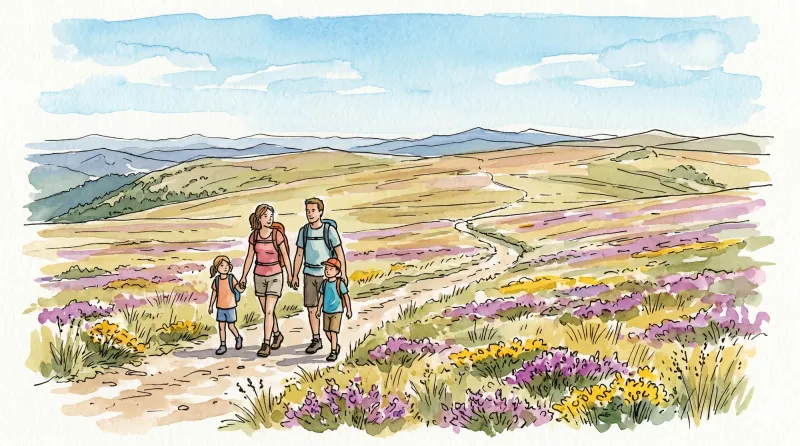
Trails around Monlet
Discover physical challenges and natural beauty in the immediate vicinity.
Explore Nearby
Complement your visit to Monlet by exploring these neighboring villages.
Allègre
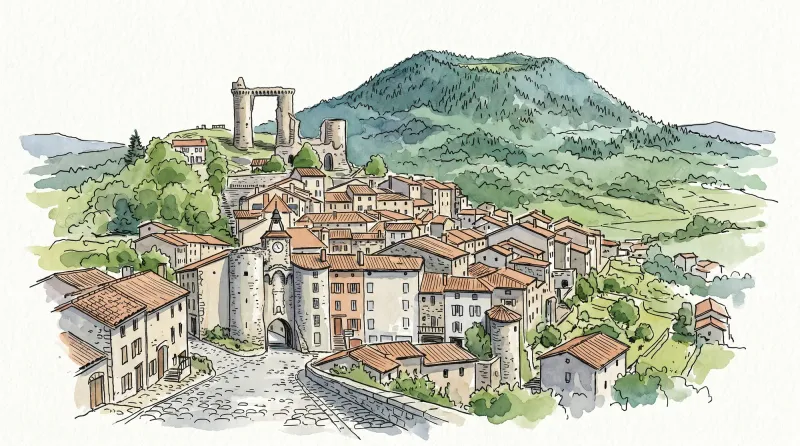
A volcanic sentinel defined by the skeletal remains of its feudal fortress and a labyrinth of fifteenth-century noble residences.
Félines
A high-altitude granitic outpost where medieval monastic influence meets the visceral beauty of Romanesque sacred art.
La Chapelle-Bertin
A high-altitude sanctuary on the granitic plateaus of the Velay, where the Senouire river carves through ancient forests and XIIth-century stone.
Saint-Pal-de-Senouire
A high-altitude sanctuary where the Senouire river cuts through ancient granite plateaus and dense fir forests.
Sembadel
A high-altitude silvan enclave where railway history meets the nascent springs of the Senouire river amidst dense resinous forests.
Varennes-Saint-Honorat
A high-altitude sanctuary where ancient woods reclaim the silence of a nearly forgotten hamlet, offering a somber and serene window into the rugged history of the Velay.