Illustration in progress
The journey into Montclard concludes at the terminus of a narrow ribbon of asphalt, where the valley floor cradles a sense of profound stillness. Here, the Église Saint-Clair presents a stark, vertical silhouette against the deep green of the surrounding canopy. Constructed in the late nineteenth century, its defining feature is the clocher-peigne—a triple-arched bell-wall that pierces the skyline with a singular, rhythmic austerity. The stone façade, etched with the names of the curate and the mason who raised it in 1875, faces a rushing stream, its orientation a departure from the traditional east-west alignment to better honor the topography of this secluded enclave.
Beyond the immediate hamlet, the landscape dissolves into a dense, sprawling woodland that accounts for nearly the entire territory. Deep within this arboreal labyrinth, the Chapelle de la Trinité emerges with an architectural ambition that defies its remote location. Known locally as “Saint-Dieu-le-Père,” this sanctuary replaced an earlier shrine in the 1890s, built to accommodate thousands of pilgrims who once converged upon its Gothic portals. Its twin slate spires rise like dark needles above the trees, while inside, the austerity of the nave is punctuated by the remnants of older frescoes and the soft echo of the Montclard stream crossing a nearby ford.
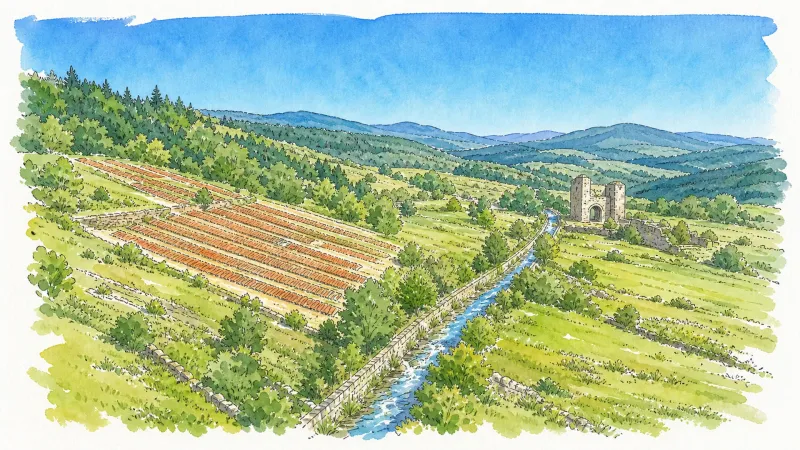
Dominating a nearby crest at an elevation of 743 meters, the fractured remains of the twelfth-century Château de Cusse stand as silent sentinels over the confluence of two streams. These jagged ruins offer a tactile connection to a feudal past, where the skeletal stone walls have been slowly reclaimed by the encroaching forest. Ascending toward these heights reveals the dramatic shifts in altitude that define the commune, transitioning from the sheltered valley floor to wind-swept ridges that touch 1,200 meters. This terrain, marked by a sparse and scattered human presence, invites a contemplative wandering through a landscape where the boundary between medieval architecture and the raw elements of the Massif Central has long since blurred.
Local profile
At a Glance
- Population
- 52
- Demonym
- —
- Altitude
- 640–1204 m
- Forest
- 85.3%
residents
local residents
lowest to highest
commune coverage
Did You Know?
“The Trinity Chapel, hidden in the woods, was once a pilgrimage site so significant it drew thousands of visitors, earning the local title "Saint-Dieu-le-Père."”
Cultural Heritage
A quiet village with authentic Auvergne charm.
Recent Wildlife & Flora Log
Nature observations recorded within 5km of Montclard.
Peacock
Carex montana L.
Marsh Valerian
Yellow Gentian
Green Carpet
Striped Hawk-moth
Peach Blossom
Chrysotoxum lessonae Giglio-Tos, 1890
Three-Humped Prominent
Purple Cloud
Explore Nearby
Complement your visit to Montclard by exploring these neighboring villages.
Berbezit
A high-altitude sanctuary on the granitic plateau of the Velay, where ancient mill ruins and a former seigneurial chapel are enveloped by a dense, resinous forest.
Chassagnes
A high-altitude sanctuary where ancient oak forests meet noble stone, offering a profound encounter with the quietude of the Haut Allier.
Collat
A high-altitude sanctuary of silence and granite, where the dense forests of the Haute-Loire meet the ancient social echoes of the Massif Central.
Connangles
A high-altitude sanctuary where ancient monastic history meets the dense, whispering forests of the granite plateau.
Saint-Didier-sur-Doulon
A vertical landscape of dense forests and feudal stone, where the Doulon river flows beneath the gaze of the monumental Château de Servières.
Saint-Pal-de-Senouire
A high-altitude sanctuary where the Senouire river cuts through ancient granite plateaus and dense fir forests.
Vals-le-Chastel
A silent sentinel of stone and timber, this ancient feudal site offers a quiet immersion into 15th-century Auvergne through its fortified chapel and haunting medieval frescoes.