Illustration in progress
The approach to Vals-le-Chastel is defined by a dramatic shift in density, where the lush canopy of the Livradois-Forez gives way to a sparse, elevated landscape. Rising above the Doulon river, the village asserts its feudal origins through the imposing silhouette of its private château. This 15th-century structure, characterized by its austere square tower and flanking round turrets, commands a vantage point that once monitored the passage of pilgrims and soldiers alike. The granite and basalt foundations of the village seem to emerge directly from the volcanic soil, creating a textural continuity between the rugged earth and the stoic, sun-bleached masonry of the few remaining dwellings.
Perched on the highest contours of the ancient motte, the Église Saint-Paul serves as a vessel for centuries of localized devotion. While its Romanesque origins remain visible in the simplicity of its three-bay nave, it is the adjacent seigniorial chapel, dedicated to Notre-Dame-des-Anges, that demands focused attention. This architectural rarity features four distinct corner watchtowers, or guérites, supporting its roof—a defensive flourish that speaks to the turbulent era of its construction. Within, the air remains cool and still, preserving the solemnity of a space that remained the private domain of the Crozet de Cumignat lineage for seven centuries before being entrusted to the community in recent years.
The interior of the chapel reveals a startling artistic legacy: a series of frescoes dating back to 1465. These pigments, applied in the wake of a black plague outbreak, depict the Virgin of Mercy extending her protective mantle over a crowd of medieval figures, their expressions frozen in a timeless plea for deliverance. The refinement of these Gothic lines contrasts sharply with the untamed forest that encircles the commune, covering over ninety percent of the territory. Even today, the village preserves its linguistic heritage through the presence of a Calandreta, where the rhythmic cadences of the Occitan tongue continue to echo, ensuring that the ancient voice of the Haut Allier remains as vibrant as the mineral tones of the chapel walls.
Local profile
At a Glance
- Population
- 39
- Demonym
- —
- Altitude
- 507–777 m
- Forest
- 90.8%
residents
local residents
lowest to highest
commune coverage
Did You Know?
“The seigniorial chapel’s vibrant 15th-century frescoes were commissioned as an act of devotion following a devastating plague epidemic in 1465.”
Cultural Heritage
Protected historic monuments in Vals-le-Chastel
Eglise Saint-Paul
les Hauts-de-Vals-le-Chatel
Recent Wildlife & Flora Log
Nature observations recorded within 5km of Vals-le-Chastel.
Carex montana L.
Green Carpet
Striped Hawk-moth
Peach Blossom
Glanville Fritillary
Chrysotoxum lessonae Giglio-Tos, 1890
Three-Humped Prominent
Purple Cloud
Green Shieldbug
Blackbird
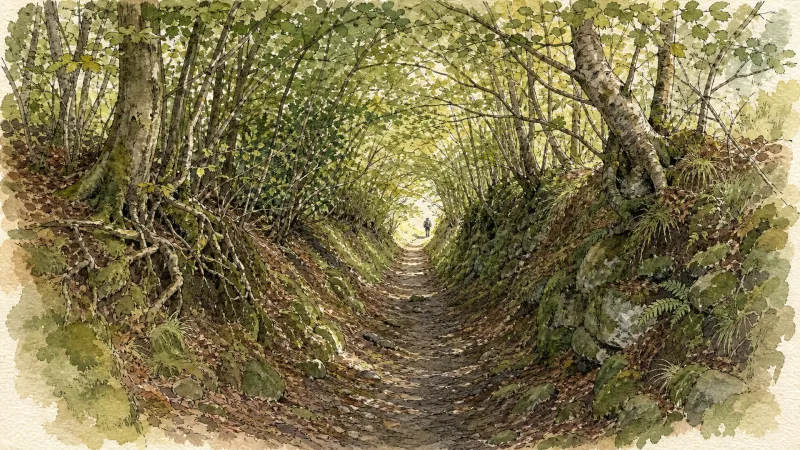
Trails around Vals-le-Chastel
Discover physical challenges and natural beauty in the immediate vicinity.
Explore Nearby
Complement your visit to Vals-le-Chastel by exploring these neighboring villages.
Chaniat
A contemplative detour into the forested uplands of Haute-Loire, where ancient Roman routes and Romanesque masonry endure.
Javaugues
A quiet enclave of the Brivadois, where Visigothic architectural echoes and 15th-century stonework punctuate a landscape of dense woodland and high meadows.
Lavaudieu
A consecrated valley where the only intact Romanesque cloister in Auvergne stands alongside a river that once mirrored the silent lives of Benedictine monials.
Montclard
A deep-valley sanctuary where silence is held by a comb-style bell tower and the skeletal remains of medieval power.