Illustration in progress
The Abbey of Saint-André de Lavaudieu stands as a singular architectural survivor, possessing the only Romanesque cloister in Auvergne to escape the ravages of time and revolution with its integrity intact. Founded in 1057 by Robert de Turlande, the site emanates a profound monastic gravity, anchored by the octagonal bell tower that rises above the stone-tiled roofs. Within the refectory, the eye is drawn to a monumental 12th-century fresco of Byzantine influence, where the rigid, noble lines of the figures offer a glimpse into the sophisticated artistic exchanges of the medieval era. This sacred space, once inhabited by Benedictine nuns, preserves an atmosphere of deliberate silence, further emphasized by the presence of a polychrome wooden Christ whose fragmented original parts now bridge the distance between the Louvre and the Metropolitan Museum of Art.
The village follows the rhythmic pulse of the Senouire, an affluent of the Allier that carves a serene path through the valley floor. Crossing the ancient stone bridge provides a vantage point to observe the vernacular architecture of the region, where the masonry reflects the geological transition of the Haut-Allier. The narrow lanes are punctuated by historical markers of local piety and craftsmanship, most notably the 1779 forged iron cross, which stands as a testament to the enduring metalworking traditions of the late 18th century. Wandering through these corridors of ochre and grey stone, one encounters a landscape that has resisted modern intrusion, maintaining the aesthetic density of a pre-industrial rural center.
Tracing the history of the commune reveals a deliberate evolution from its original identity as Comps to its 15th-century designation as Lavaudieu, or the “Valley of God.” This renaming, authorized by King Charles VII in 1487, solidified the village’s status as a sanctuary of spiritual retreat. The integration of the nearby hamlet of Lugeac in 1842 expanded the territorial reach of the commune into higher elevations, yet the heart of the settlement remains concentrated around the abbey’s shadow. For the traveler arriving from their nearby estate, Lavaudieu offers a concentrated immersion into the monastic heritage of the Massif Central, where the marriage of Romanesque stone and riverine landscape creates a tableau of immense historical depth.
Local profile
At a Glance
- Population
- 243
- Demonym
- —
- Altitude
- 438–727 m
- Forest
- 36.5%
residents
local residents
lowest to highest
commune coverage
Did You Know?
“The village houses a high-fidelity ash wood replica of a famous 12th-century polychrome Christ; the original’s head is held by the Louvre, while its torso is part of the Metropolitan Museum of Art’s collection in New York.”
Cultural Heritage
Protected historic monuments in Lavaudieu
Ancienne abbaye Saint-André-de-Lavaudieu
Lavaudieu
Eglise abbatiale
Lavaudieu
Croix en fer forgée datée de 1779
Sur la place principale devant l'abbaye
Recent Wildlife & Flora Log
Nature observations recorded within 5km of Lavaudieu.
Common Linnet
Black Redstart
Blackcap
Certhia brachydactyla C.L.Brehm, 1820
Great Crested Grebe
Fox Moth
Eurasian Jay
Common Fire Salamander
Great Tit
Aligot comú
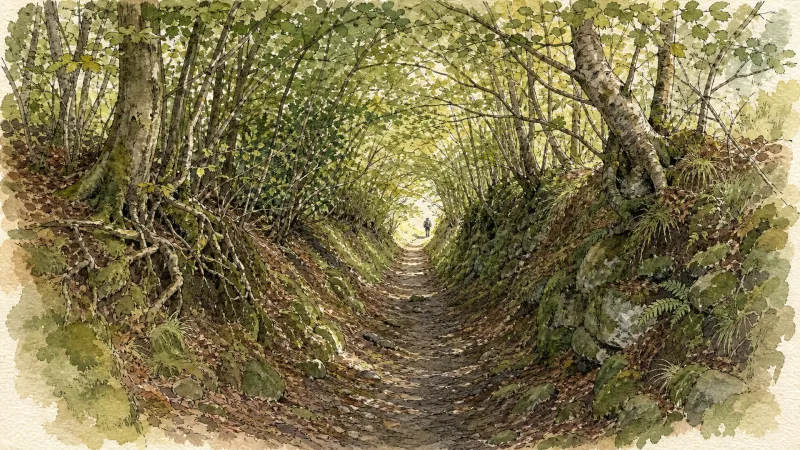
Trails around Lavaudieu
Discover physical challenges and natural beauty in the immediate vicinity.
Explore Nearby
Complement your visit to Lavaudieu by exploring these neighboring villages.
Chaniat
A contemplative detour into the forested uplands of Haute-Loire, where ancient Roman routes and Romanesque masonry endure.
Javaugues
A quiet enclave of the Brivadois, where Visigothic architectural echoes and 15th-century stonework punctuate a landscape of dense woodland and high meadows.