Illustration in progress
The Doulon river carves a deliberate path through a landscape dominated by the silent beauty of ancient woodlands. Covering over three-quarters of the territory, these forests create a vertical world where the altitude climbs sharply from the water’s edge at 550 meters to the rugged ridges of 1,089 meters. This elevation once earned the commune the revolutionary title of Didier-des-Côtes, a name that captures the sheer incline of the terrain. For the afternoon visitor, the air here carries a crystalline sharpness typical of the mountain margins, where the summer heat is tempered by the profound shade of the timber stands.
Within the village and its outlying reaches, the architecture speaks of endurance and feudal weight. The Château de Servières commands attention with its historical gravity, a structure protected for its significance and defined by the stark, noble geometry of Haute-Loire masonry. Nearby, the parish church of Saint-Didier anchors the center, its stone surfaces weathered by centuries of Atlantic and continental winds. There is a tactile quality to the masonry here—coarse, lichen-dusted, and deeply rooted in the volcanic soil—reflecting a time when these valley strongholds were essential for monitoring the passage between the Velay and the Allier.
Beyond the main cluster, the commune fragmentizes into a network of solitary hamlets, each guarding its own sacred relics. The chapel of Saint-Abdon-et-Saint-Sennen at Cénat and the Saint-Roch chapel at La Vernède stand as silent witnesses to a rural devotion that has largely outlived the shifting tides of the modern world. Wandering these paths reveals a rhythm dictated by the seasons and the slow growth of the forest, far removed from the hurried pace of urban centers. It is a destination for quiet observation, where the play of light through the canopy and the echo of the Doulon over river stones provide the only soundtrack to an afternoon of immersion in the Haute-Loire interior.
Local profile
At a Glance
- Population
- 197
- Demonym
- —
- Altitude
- 550–1089 m
- Forest
- 77.2%
residents
local residents
lowest to highest
commune coverage
Did You Know?
“During the French Revolution, the commune was stripped of its religious title and rechristened "Didier-des-Côtes" to reflect its steep, hillside geography.”
Cultural Heritage
A quiet village with authentic Auvergne charm.
Recent Wildlife & Flora Log
Nature observations recorded within 5km of Saint-Didier-sur-Doulon.
Glanville Fritillary
Dasylobus graniferus (Canestrini, 1872)
Blackbird
Crested Tit
Shrubby Germander
Black Oil-beetle
Dead Moll's Fingers
Speckled Yellow
Red Admiral
Trichodes alvearius (Fabricius, 1792)
Explore Nearby
Complement your visit to Saint-Didier-sur-Doulon by exploring these neighboring villages.
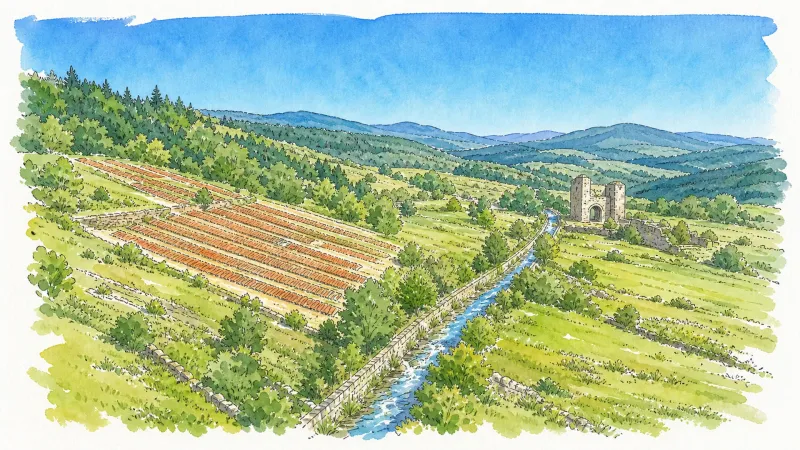
Berbezit
A high-altitude sanctuary on the granitic plateau of the Velay, where ancient mill ruins and a former seigneurial chapel are enveloped by a dense, resinous forest.
Champagnac-le-Vieux
A high-altitude sanctuary of granite masonry and medieval fortifications, offering an immersive look into the history of itinerant master builders and defensive priories.
Chaniat
A contemplative detour into the forested uplands of Haute-Loire, where ancient Roman routes and Romanesque masonry endure.
Cistrières
A high-altitude sanctuary of granite and forest on the Velay plateau, offering a quiet encounter with 12th-century Romanesque masonry.
Javaugues
A quiet enclave of the Brivadois, where Visigothic architectural echoes and 15th-century stonework punctuate a landscape of dense woodland and high meadows.
Laval-sur-Doulon
A high-altitude sanctuary where the phantom echoes of Templar knights linger amidst eighty-five percent forest coverage and ancient granite ruins.
Montclard
A deep-valley sanctuary where silence is held by a comb-style bell tower and the skeletal remains of medieval power.
Vals-le-Chastel
A silent sentinel of stone and timber, this ancient feudal site offers a quiet immersion into 15th-century Auvergne through its fortified chapel and haunting medieval frescoes.