Illustration in progress
Rising toward the rugged spine of the Forez, Viscomtat reveals itself through a mosaic of granite outcroppings and immense coniferous stands. The air here carries the sharp clarity of the 1,123-meter summit, where the landscape transitions from high-altitude pastoral meadows to the deep, silent shadows of the Bois de la Faye. This is a territory of scattered stone dwellings rather than a concentrated center, where the rhythm of life is dictated by the steep incline of the slopes and the ancient, unyielding boundaries of the forest canopy.
At the heart of the primary settlement stands the Église Saint-Taurin, a stone sentinel that served as a private sanctuary for a noble fortress long since reclaimed by the earth. Within its walls, the architecture yields an acoustic purity that attracts visiting musicians, offering a refined interior experience that contrasts with the wild, windswept terrain outside. Higher still, among the pines of the Faye ridge, a somber historical weight lingers where a Vickers Viscount met its end in 1972, leaving an indelible, tragic mark on the local lore of these mist-shrouded heights.
Modern vitality in these highlands finds expression through the specialized craft of apiculture and the disciplined precision of traditional archery. The local “Cité de l’abeille” serves as a dedicated conservatory for the honeybee, celebrating its essential role in this fragile alpine ecosystem through annual festivals of entomology and art. In the lower valleys, the slow, deliberate pace of animal-powered agriculture preserves a level of biodiversity that feels both archaic and revolutionary, anchoring the commune in a sustainable, tactile reality far removed from the frantic pace of the plains below.
Local profile
At a Glance
- Population
- 501
- Demonym
- —
- Altitude
- 606–1123 m
- Forest
- 63.9%
residents
local residents
lowest to highest
commune coverage
Did You Know?
“The village church, Saint-Taurin, was originally the private chapel of a medieval castle that has since completely vanished from the landscape.”
Cultural Heritage
A quiet village with authentic Auvergne charm.
Recent Wildlife & Flora Log
Nature observations recorded within 5km of Viscomtat.
Aligot comú
Two-coloured Daffodil
European Red Elder
Common Sundew
Large Red Damsel
Magpie
Stag Beetle
Oak Eggar
Comma
Common Frog
Trails around Viscomtat
Discover physical challenges and natural beauty in the immediate vicinity.
Des Margerides au Grun de Chignore (circuit route n°7)
Discover this trail through the heart of Livradois-Forez.
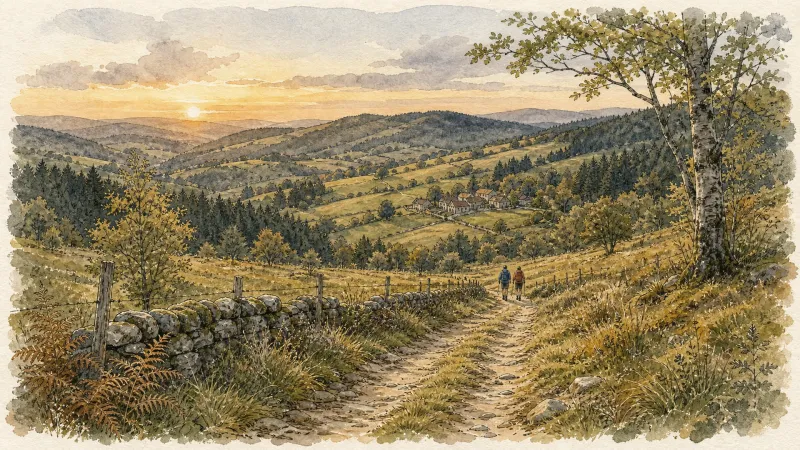
Fontbonne (circuit n°29)
Discover this trail through the heart of Livradois-Forez.

GR®3 — The Forez Mountains
The GR®3 is a legendary long-distance trail following the Loire, one of Europe’s last wild rivers, for 1,200 km. It begins at the river’s source on Mont Gerbier de Jonc and continues to its estuary near Guérande. The section across the Forez mountains unfolds through a succession of striking panoramas, peat bogs, moorland, winding rivers and vast open spaces.
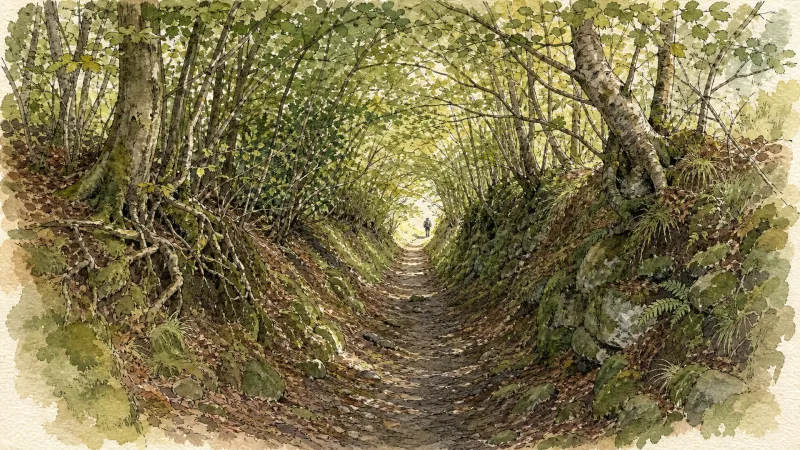
GR®89 Le Chemin de Montaigne
Discover this trail through the heart of Livradois-Forez.
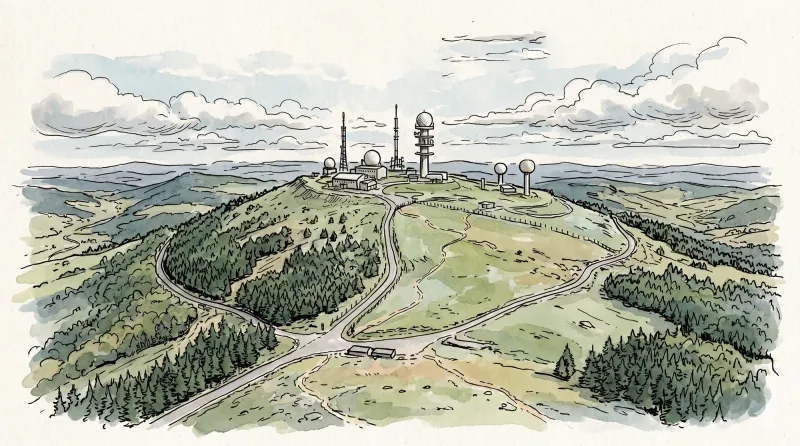
The Olmes cross (circuit n°43)
Discover this trail through the heart of Livradois-Forez.
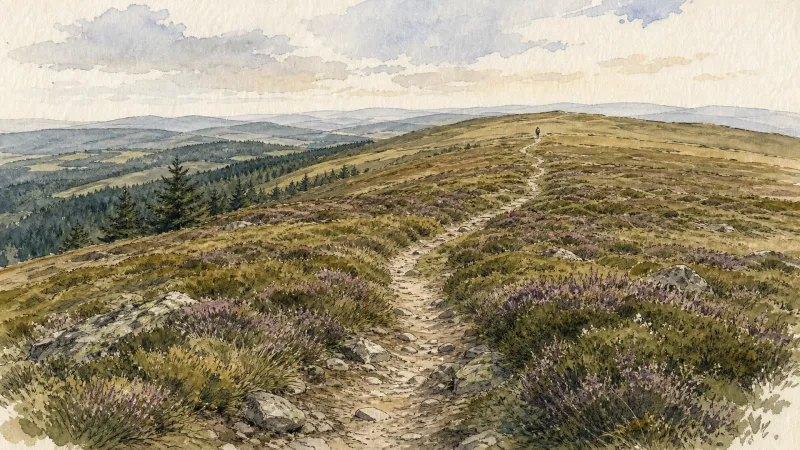
The family (circuit n°40)
Discover this trail through the heart of Livradois-Forez.
Explore Nearby
Complement your visit to Viscomtat by exploring these neighboring villages.
Celles-sur-Durolle
A high-altitude sanctuary where the rugged industrial heritage of the Durolle valley meets the silent, dense forests of the Forez mountains.
Chabreloche
A high-altitude threshold where the granite of the Puy-de-Dôme meets the Loire, defined by dense forest canopies and a rare convergence of ancient regional dialects.
Noirétable
A high-altitude sanctuary where ancient monastic silence meets the rugged craft of the Bois Noirs forest.
Sainte-Agathe
An elevated sanctuary of dense woodland and medieval stone, offering sweeping vistas from the rugged heights of the Livradois-Forez.
Vollore-Montagne
A high-altitude sanctuary on the western spine of the Monts du Forez, where granite monoliths and 14th-century boundary stones tell of medieval lineages and geological wonders.