Illustration in progress
Rising toward the heavens on the eastern fringes of the Issoire district, Peslières is a domain defined by its verticality and its agricultural ghosts. The name itself, derived from the 14th-century Occitan Paylleras, evokes a landscape once dominated by golden stacks of straw and the sturdy granaries required to protect the harvest from the unforgiving mountain winters. Today, the village center occupies a narrow ledge of civilization, flanked by slopes that climb to over 1,100 meters. Visitors will find the air here carries a sharpened clarity, characteristic of the high-altitude transition where the pastoral valleys of the Puy-de-Dôme surrender to the dense, brooding canopy of the Livradois-Forez.
The village’s architectural soul is anchored by its Gothic church, a structure that has weathered centuries of remodeling yet retains a stark, devotional gravity. Within its cool, stone-quiet interior, one finds the “Décollation de saint Jean-Baptiste,” a thematic nod to the parish patron that infuses the site with a sense of solemnity. The exterior masonry reflects the local geology, with stones that have absorbed the damp mists of the mountain margins, resulting in a patina that speaks of endurance. This is a place for quiet observation of the sacred and the survivalist, where the transition from medieval paille—the straw—to the permanence of granite is visible in every lintel and threshold.
Beyond the immediate cluster of the bourg, the commune dissolves into a tapestry of over fifty hamlets and clearings, nearly three-quarters of which are reclaimed by thick, undulating woodland. Exploring the periphery leads to the historic site of Châteauneuf, the ancestral seat of the Du Drac family, whose heraldic green dragon still flickers in the local imagination and on the communal blazon. The rhythm of a visit here is dictated by the density of the forest and the sudden, sweeping vistas of the Massif Central that emerge through the pines. It is a landscape of solitude and silence, where the only intrusion is the wind moving through the high timberlands that wrap the commune in a perpetual, verdant embrace.
Local profile
At a Glance
- Population
- 56
- Demonym
- —
- Altitude
- 591–1158 m
- Forest
- 74.9%
residents
local residents
lowest to highest
commune coverage
Did You Know?
“The commune's heraldic shield features a green dragon, a tribute to the noble Du Drac family who historically resided in the hamlet of Châteauneuf.”
Cultural Heritage
A quiet village with authentic Auvergne charm.
Recent Wildlife & Flora Log
Nature observations recorded within 5km of Peslières.
Striped Hawk-moth
Meadow Campion
Red-Belted Bracket
Bilberry
Lanius collurio Linnaeus, 1758
Orange Swift
Common Sunfish
Beech
Bird's-foot
Froghopper
Trails around Peslières
Discover physical challenges and natural beauty in the immediate vicinity.
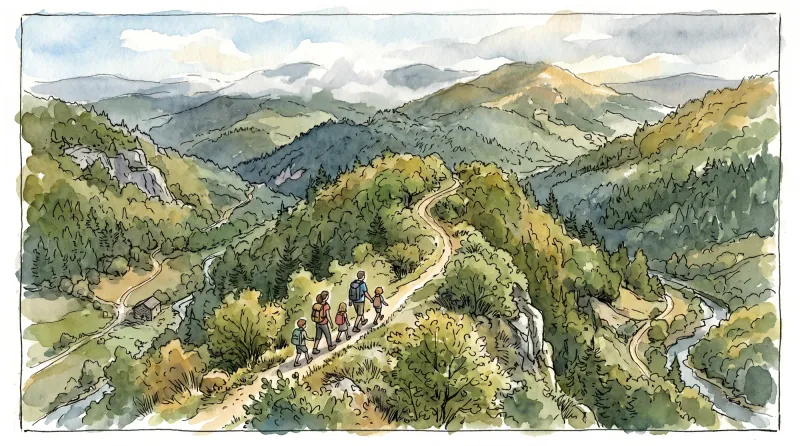
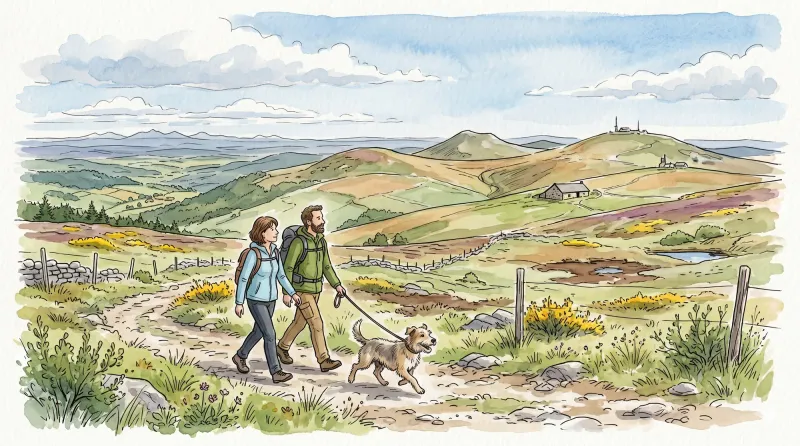
Ridge walk
A circuit in the highlands of Ste-Catherine (14th century church) with panoramic views of the Dôme mountains, the Dore and Cézallier mountains as well as two beautiful crosses in the hamlets of Moulin à vent and Peslières.
The Three Valleys
Departure - From the departure sign go down a small street below and to the right of the D24. Turn immediately right onto a grassy path between 2 low walls. Continue downhill and at the 1st T-junction, turn right and at the 2nd left. At a place called “Le Cerf” cross a stone bridge. Climb through the undergrowth, leaving the path on the right. Continue the ascent to the D24. 1 - Go up it for 20 m and take the path on the left. Continue, ignoring two paths on the left until you reach the hamlet “Le Ceilloux”. At the exit join the D33, take it on the left until Peslières (near the church, a German cannon dating from the 14-18 war). At the exit of the village, go up the tarmac path on the right to Lospeux. Pass in front of the cross on the right, continue to climb the path. Cross several hamlets until you reach the D702. 2 - Cross it, head on the tarmac path to the left of the sawmill. Then at the granite cross, take the middle path and walk through the woods. At the T-junction, turn left onto the forest path. Leave 2 paths on the right. Proceed to the D33 (leaving the woods, viewpoint over the Cézallier mountains, the Monts Dore and the Chaîne des Puys; orientation table on the D33 on the left at 200 m). 3 - Go down a wide path opposite. At the D132E turn left. 400 m after leaving the hamlet of Edmesse, turn right onto a dirt road. At the crossroads, continue straight on until the D266E. 4 - Take the tarmac path opposite. Continue right. At the first house on the right of the hamlet of La Voissière, go down to the right on a path. Cross a first stream on a granite slab, turn left, take a bridge which crosses the Chateauneuf stream. After the bridge, turn left and go straight on, ignoring the path on the right. At an intersection continue right until the crossroads after the hamlet of Rodel. 5 - Turn left. At the fork stay left. 500 m after the place called Charbonne go up to the right in the forest. At a crossroads, continue straight ahead. At the next crossroads of 5 paths (storage area), go down a wide path on the left. Continue straight ahead. At the cross turn left on the road to reach the starting point.
Explore Nearby
Complement your visit to Peslières by exploring these neighboring villages.
Champagnat-le-Jeune
A high-altitude rural enclave where the silence of the Livradois-Forez forests meets the austere beauty of Romanesque masonry.
Fayet-Ronaye
A dual-parish destination carved by the Doulon valley, offering a somber meditation on Druidic legends and fortified Romanesque sanctity.
Saint-Germain-l'Herm
A high-altitude ridge settlement characterized by ancient megalithic sites, a fortified Romanesque priory, and a storied history of timber craftsmanship for the Royal Navy.
Saint-Martin-d'Ollières
A high-altitude sanctuary on the border of the Livradois and Brivadois, where the legacy of medieval potters meets the quietude of dense montane forests.
Sainte-Catherine
A high-altitude sanctuary where Romanesque simplicity meets the silent, vast stretches of the Forez forests.
Valz-sous-Châteauneuf
A high-altitude sanctuary where Romanesque sobriety meets an unlikely presidential legacy amidst dense forests and mountain streams.