Illustration in progress
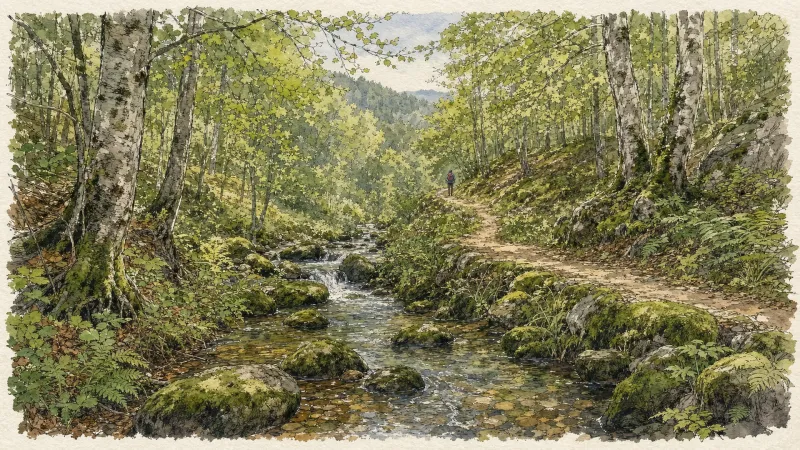
Fayet-Ronaye presents a bifurcated geography, where the Doulon valley slices through the granite high-plateaus to separate two ancient parishes. At altitudes reaching 1,145 meters, the air carries a sharp, highland clarity, and the landscape is dominated by a dense, emerald canopy of forest that covers over eighty percent of the territory. Visitors wandering through the dispersed hamlets like La Baffie or Villeprat will encounter a terrain defined by rugged verticality, where the rhythm of the water in the valley floor contrasts with the silent, expansive stretches of moorland above. The physical separation of the two village cores creates a unique spatial tension, inviting a slow traversal of the gorges and ridges that have dictated local life for centuries.
The historical gravity of the area centers on the Lou Schou Dissard, an imposing earthen monument measuring forty meters in length that rises from the landscape near the bridge over the Doulon. Local tradition elevates this site beyond a mere medieval motte, identifying it as the “Tumulus of the Poudrière” where the last vestiges of a sacred Druidic tribe were purportedly interred following a catastrophic defeat by Roman legions. Whether one views the mound as a tactical fortification or a Gallic reliquary, its presence lends a mythic weight to the valley. The shadows of Vercingétorix and the legendary priest Diviciac haunt the surrounding caves and the Roche-Combaud, where the stone outcrops and cascading waters seem to echo with the ancient resonances of a lost Celtic aristocracy.
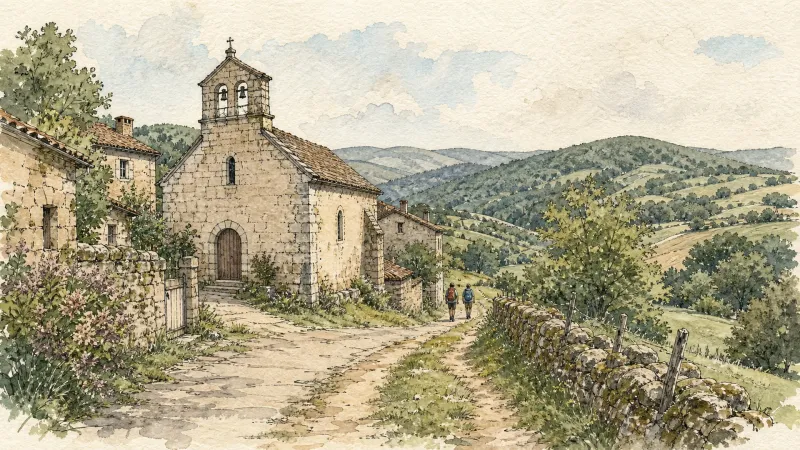
Architectural sobriety finds its expression in the Église Saint-Barthélemy at Fayet, a structure that reveals the defensive anxieties of the fourteenth and fifteenth centuries. The Romanesque core of the building was reinforced with fortifications, creating a sanctuary of stone that feels both spiritual and sentinel-like. Inside, the broken barrel vaults guide the eye toward a polyhedral apse, while the late Gothic wooden Christ—protected for its exceptional craftsmanship—retains a haunting, tactile presence. While the sister church in Ronaye remains a silent observer of the passage of time, the fortified lines and Casadean heritage of Fayet provide a profound glimpse into the medieval psyche of the Livradois, where faith was frequently etched into the very granite that defines these high summits.
Local profile
At a Glance
- Population
- 116
- Demonym
- —
- Altitude
- 823–1145 m
- Forest
- 83.3%
residents
local residents
lowest to highest
commune coverage
Did You Know?
“Local legend suggests the "Lou Schou Dissard" tumulus holds the remains of Druidic priests who fled Julius Caesar’s legions.”
Cultural Heritage
Protected historic monuments in Fayet-Ronaye
Motte castrale de Fayet dite suc Dissard
Fayet-Ronaye
Recent Wildlife & Flora Log
Nature observations recorded within 5km of Fayet-Ronaye.
Angelica sylvestris L.
Meadow Campion
Light Emerald
Red-Belted Bracket
Marbled White
Silver-washed Fritillary
Meadow Brown
Bilberry
Barn Swallow
Anec coll-verd
Trails around Fayet-Ronaye
Discover physical challenges and natural beauty in the immediate vicinity.
Circuit n°40 Bellevue et le bois de la Vierge
Secteur Saint-Germain-l'Herm
Circuit n°41 Etang de Marchaud
Secteur Saint-Germain-l'Herm
La Baffie
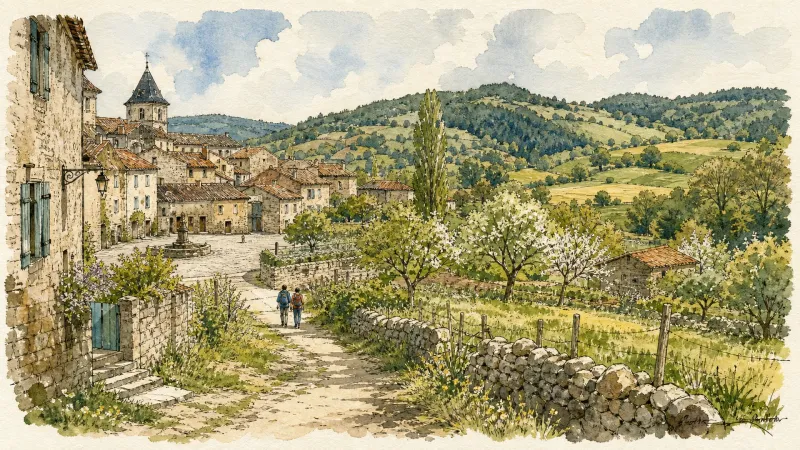
A walk from Fayet-Ronaye, whose Romanesque church was altered in the 14th century, across steep, extensively wooded slopes with views over the surrounding forested hills. Ronaye has a beautiful granite cross dating from the late 14th century.
Explore Nearby
Complement your visit to Fayet-Ronaye by exploring these neighboring villages.
Doranges
A high-altitude sanctuary of dense forests and Romanesque stone, where ancient hydraulic mills and revolutionary history converge on the roof of the Livradois.
Peslières
A high-altitude sanctuary of ancient granaries and deep timberlands, offering a somber Gothic church and the echoes of the noble Du Drac lineage.
Saint-Bonnet-le-Bourg
A high-altitude sanctuary where the Dore river begins its journey amidst ancient Romanesque stonework and deep monastic forests.
Saint-Germain-l'Herm
A high-altitude ridge settlement characterized by ancient megalithic sites, a fortified Romanesque priory, and a storied history of timber craftsmanship for the Royal Navy.
Saint-Martin-d'Ollières
A high-altitude sanctuary on the border of the Livradois and Brivadois, where the legacy of medieval potters meets the quietude of dense montane forests.