Illustration in progress
Upon ascending the eastern ramparts of the Livradois, one encounters a landscape defined by granite and deep-reaching coniferous shadows. This territory, perched at elevations reaching over eleven hundred meters, was once a center of primitive industry, its identity forged in the heat of kilns. The “Ollières” suffix serves as a linguistic fossil, recalling a time when the local earth was turned into oules—the sturdy earthenware jars essential to medieval Auvergnat households. Today, the air carries a distinct montane clarity, filtered through a canopy that covers seventy percent of the communal bounds, offering a cool respite for an afternoon of quiet contemplation.
The historical narrative of the parish is a somber tale of survival and migration. Originally centered around the hamlet of Soulages, the community’s spiritual life revolved around a primitive church dedicated to Saint Martin, founded under the influence of the Abbey of La Chaise-Dieu. However, the spectral hand of the plague eventually scoured the original settlement, forcing the survivors to retreat seven kilometers to the potters’ village of Ollières. This exodus left the original sanctuary to the mercy of the elements; by the mid-twentieth century, only skeletal fragments of its walls remained, and today, those ruins have largely dissolved back into the soil, leaving only the dual name as a testament to this geographic shift.
Wandering through the current village center reveals the 1827 Church of Saint Côme and Saint Damien, a structure built to replace the abandoned chapels of the past. The interior houses a registered processional cross, a delicate piece of metalwork that contrasts with the ruggedness of the surrounding timberlands. Beyond the stone lavoir, the terrain breaks into a network of over sixty named localities and hamlets, such as Estroupiat and Riol, each a quiet cluster of stone outposts. These granite settlements sit amidst high pastures and dense forests, offering a silent meditation on the isolation and endurance of the upper Massif Central.
Local profile
At a Glance
- Population
- 149
- Demonym
- —
- Altitude
- 547–1120 m
- Forest
- 70.3%
residents
local residents
lowest to highest
commune coverage
Did You Know?
“The name "Ollières" originates from "oules," medieval earthenware jars once crafted from the local clay.”
Cultural Heritage
A quiet village with authentic Auvergne charm.
Recent Wildlife & Flora Log
Nature observations recorded within 5km of Saint-Martin-d'Ollières.
Heath Spotted-Orchid
Meadow Campion
Lución
Red-Belted Bracket
Silver-washed Fritillary
Parasol
Bird's-foot
Froghopper
Silver-moss
European Field Pansy
Explore Nearby
Complement your visit to Saint-Martin-d'Ollières by exploring these neighboring villages.
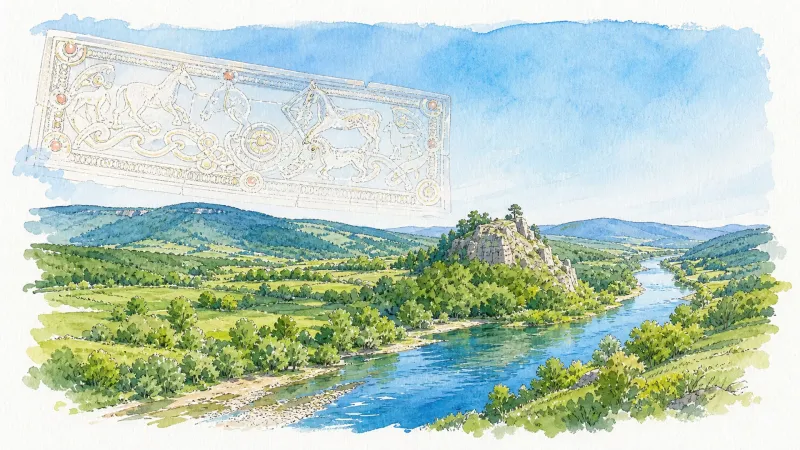
Auzon
A medieval stronghold perched on a volcanic spur, where Romanesque architecture and feudal remnants overlook the shifting currents of the Allier.
Fayet-Ronaye
A dual-parish destination carved by the Doulon valley, offering a somber meditation on Druidic legends and fortified Romanesque sanctity.
Peslières
A high-altitude sanctuary of ancient granaries and deep timberlands, offering a somber Gothic church and the echoes of the noble Du Drac lineage.
Saint-Hilaire
A high-altitude sanctuary defined by Romanesque stonecraft and the spectral ruins of the Château de Valivier, perfect for an afternoon immersed in the quietude of the Haut-Allier.
Saint-Jean-Saint-Gervais
A solitary granitic peak hosting a rare architectural porch and the remnants of a Merovingian baptismal site, surrounded by dense forests and scattered hamlets.
Valz-sous-Châteauneuf
A high-altitude sanctuary where Romanesque sobriety meets an unlikely presidential legacy amidst dense forests and mountain streams.