Illustration in progress
The topography of Saint-Jean-Saint-Gervais defies the traditional French village structure, eschewing a central square for a dramatic, solitary concentration atop a granitic peak. Here, the ecclesiastical heart of the commune stands in splendid isolation, comprising the church, a silent cemetery, and the skeletal remains of a ruined presbytère. This austere assembly, perched high above the surrounding valleys, offers an unmediated encounter with the region’s geological bones. To wander this summit is to feel the weight of centuries-old stone against the expansive, often turbulent sky of the Puy-de-Dôme, where the wind hums through the gaps in the ancient masonry.
Tracing its lineage back to the Merovingian era, the site once served as a fortified baptismal stronghold, a role that echoes in the enduring presence of the Baptistère Saint-Jean-Baptiste. The Église Saint-Pierre exhibits the rugged elegance of 12th-century Romanesque design, characterized by its barrel-vaulted nave and rhythmic stone modillons. Of particular interest to the architectural enthusiast is the ganivelle porch—a distinctive regional feature shared with the great basilicas of Auzon and Brioude—which provides a transitional space of light and shadow before entering the cool, hushed interior of the sanctuary. Though extensively remodeled in the 15th and 16th centuries, the building retains a primitive, grounded power that commands the horizon.
Beyond the ecclesiastical heights, the commune dissolves into a tapestry of seventy-four percent forest cover, where the air carries the sharp scent of resin and damp earth. Life here is not gathered, but scattered across dozens of tiny hamlets such as Lavialle, Gourdine, and Espessous, each connected by narrow trails that weave through dense stands of timber and high-altitude pastures. These clusters of farmsteads and mills, often built from the same grey granite as the peak itself, appear as natural outcroppings within the landscape. For the afternoon traveler, a slow circuit through these wooded reaches reveals the quiet rhythm of a territory where nature has long held the upper hand over urban density.
Local profile
At a Glance
- Population
- 126
- Demonym
- —
- Altitude
- 455–767 m
- Forest
- 73.9%
residents
local residents
lowest to highest
commune coverage
Did You Know?
“During the fervor of the French Revolution, the commune was stripped of its hagiographic name and briefly rechristened "Goulache."”
Cultural Heritage
Protected historic monuments in Saint-Jean-Saint-Gervais
Eglise Saint-Jean-Baptiste
Saint-Jean-Saint-Gervais
Recent Wildlife & Flora Log
Nature observations recorded within 5km of Saint-Jean-Saint-Gervais.
Lamium purpureum L.
European chickweed
Heath Spotted-Orchid
Aiolopus strepens (Latreille, 1804)
Lución
Volucella inflata (Fabricius, 1794)
Facelia
Lamium album L.
Painted Lady
Black Redstart
Explore Nearby
Complement your visit to Saint-Jean-Saint-Gervais by exploring these neighboring villages.
Auzon
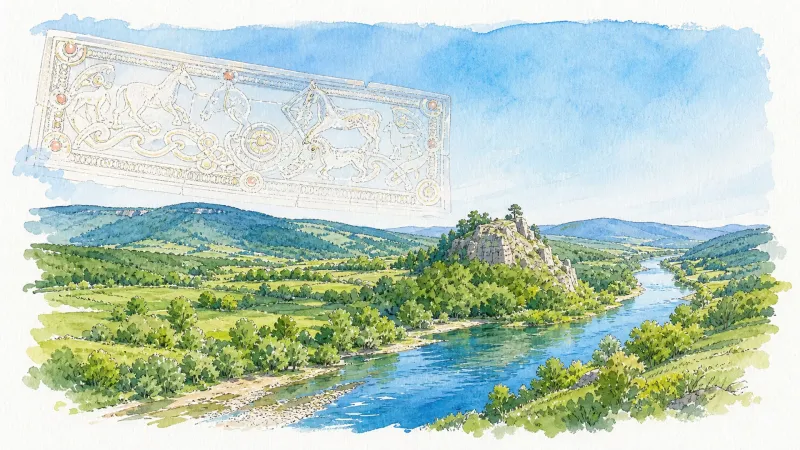
A medieval stronghold perched on a volcanic spur, where Romanesque architecture and feudal remnants overlook the shifting currents of the Allier.
Champagnat-le-Jeune
A high-altitude rural enclave where the silence of the Livradois-Forez forests meets the austere beauty of Romanesque masonry.
Esteil
A high-altitude sanctuary of silence, where a split Romanesque priory and ancient waterworks tell a story of monastic devotion and wartime scars.
La Chapelle-sur-Usson
A high-altitude sanctuary of ancient forests and noble lineage, where the dispersed hamlets of the Livradois-Forez reveal the quiet majesty of the Auvergne highlands.
Valz-sous-Châteauneuf
A high-altitude sanctuary where Romanesque sobriety meets an unlikely presidential legacy amidst dense forests and mountain streams.