Illustration in progress
At an elevation reaching 1,121 meters, Doranges presents a landscape dominated by a dense, silent arboreal canopy that claims over seventy percent of the territory. The air here carries the sharp clarity of the high Livradois, where the granite soil once belonged to a Gallo-Roman named Daurus. This ancient agricultural legacy persists in the fragmented layout of the commune, which eschews a singular center for a constellation of hamlets like Chard and Combris. Walking through these spaces, one feels the weight of a geography that historically forced its inhabitants to become seasonal sawyers and stonecutters, traveling far across France while the high-altitude winters gripped their ancestral stone.
The spiritual heart of the village beats within the Church of Saint-Barthélemy, a twelfth-century Romanesque structure that reveals the rugged devotion of the Middle Ages. Its stone is defined by a deliberate rusticity, featuring historiated modillons and capitals carved with low-relief figures that whisper of a pre-monastic era. While the region is often associated with the later influence of La Chaise-Dieu, the dedication of this site to Saint Julien suggests an older lineage of evangelization linked to the missionaries of Brioude. The interior chapels, added in the fifteenth century, served as the final resting places for the local nobility of Scis and Le Boucheron, anchoring the village’s social hierarchy in the cool silence of the nave.
Water governs the historical rhythm of the lower slopes, where fifteen hydraulic mills once harnessed the modest flow of local streams to grind grain for the surrounding plateau. The Moulin de Piers stands as a restored witness to this industrious past, offering a tactile connection to the era of the “échalassiers” who carved vineyard stakes from the surrounding woods. Local history is further colored by the presence of Jean de La Roque, an aristocrat who navigated the terrors of the Revolution by shedding his noble title to serve as a civilian mayor. His legacy, much like the 1881 carved fountain in the center of the village, reflects a community that has survived through pragmatic adaptation and a profound connection to its unforgiving, yet majestic, environment.
Local profile
At a Glance
- Population
- 178
- Demonym
- —
- Altitude
- 865–1121 m
- Forest
- 71.1%
residents
local residents
lowest to highest
commune coverage
Did You Know?
“During the French Revolution, the local lord Jean de La Roque renounced his noble "De" to become simply "Laroque" to appease the radicals in Ambert, yet he remained so popular that his constituents protected him throughout the Terror.”
Cultural Heritage
A quiet village with authentic Auvergne charm.
Recent Wildlife & Flora Log
Nature observations recorded within 5km of Doranges.
Angelica sylvestris L.
Yellow-faced Blowfly
Comma
Marbled White
Silver-washed Fritillary
Black-Tailed Skimmer
Azure Bluet
Common Juniper
Dwarf Gorse
Facelia
Trails around Doranges
Discover physical challenges and natural beauty in the immediate vicinity.
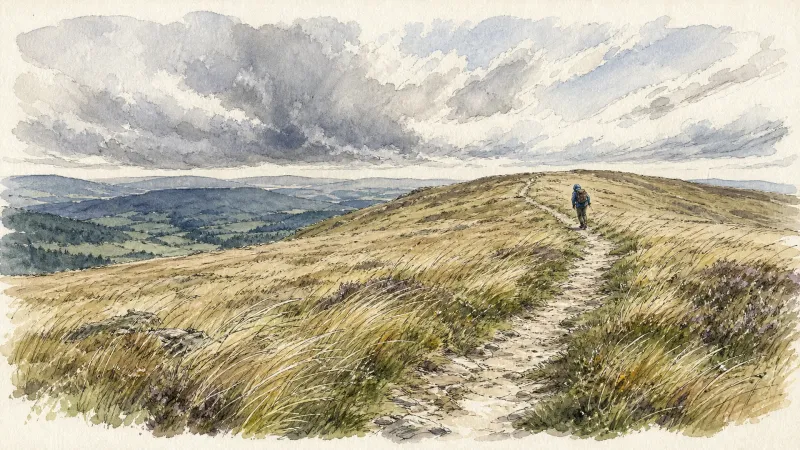
Dore Loop
The Livradois-Forez Regional Natural Park, a land of grassland and woodland, promises a memorable journey between valleys and ridges.
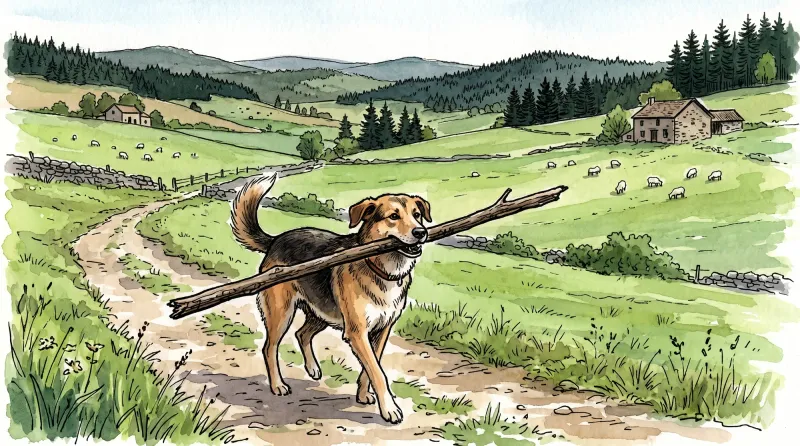
Great Livradois-Forez Mountain-Bike Traverse
In the heart of Auvergne, the Great Livradois-Forez Traverse takes you around the Livradois-Forez Regional Natural Park, between two mountain ranges rising from 400 m to 1,600 m.
The Haute Dore
From the Vernet mill to the Piers mill, via the old Aubapeyre quarry, discover the numerous and melancholy traces of Haute-Dore's industrial past.
Explore Nearby
Complement your visit to Doranges by exploring these neighboring villages.
Fayet-Ronaye
A dual-parish destination carved by the Doulon valley, offering a somber meditation on Druidic legends and fortified Romanesque sanctity.
Laval-sur-Doulon
A high-altitude sanctuary where the phantom echoes of Templar knights linger amidst eighty-five percent forest coverage and ancient granite ruins.
Novacelles
A deep-valley sanctuary where 14th-century frescoes and the haunting ruins of a ghost village reveal the ancient spiritual core of the Livradois.
Saint-Alyre-d'Arlanc
A high-altitude forest enclave defined by a tragic martyr's legend and the austere granite lines of 13th-century fortifications.
Saint-Bonnet-le-Bourg
A high-altitude sanctuary where the Dore river begins its journey amidst ancient Romanesque stonework and deep monastic forests.
Saint-Sauveur-la-Sagne
A high-altitude sanctuary defined by its ancient arboreal sentinel and the rhythmic passage of vintage rail through dense coniferous stands.