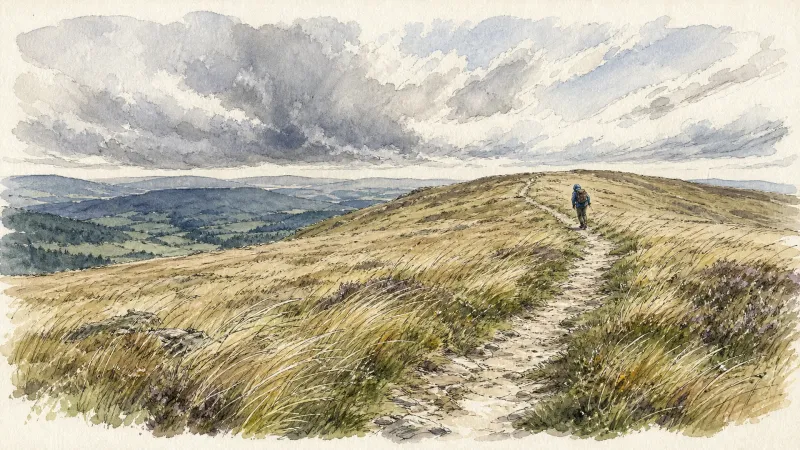
Illustration in progress
The name Orléat echoes the Gallo-Roman era, derived from the estate of a certain Aurelius who once commanded these fertile lands. The village core is anchored by a Romanesque church, where the interior stillness is punctuated by the presence of ancient frescoes. These medieval pigments offer a silent dialogue with the stone, surviving the rise and fall of various noble houses like La Forest and Le Miral that once governed the surrounding hamlets. Wandering through the village, one senses the weight of this feudal history, etched into the arrangement of the disparate hamlets that pattern the landscape between the Dore river and the Bournat plain.
Beyond the stone and mortar lies a geological anomaly: the continental dune of Girauds-Faure. Formed twenty million years ago at the ancient confluence of the Allier and the Dore, this fine-grained landscape supports a biological rhythm more common to the Atlantic coast than the heart of Auvergne. Here, the silver-green tufts of Corynephorus grass grip the shifting sands, providing a habitat for predatory wasps and the iridescent European bee-eater. This site, protected under Natura 2000, offers a tactile experience of deep time, where the earth reveals its prehistoric riverbed origins beneath the modern canopy of the forest.
The banks of the Dore at Pont-Astier whisper of a time when transit was a slow, cable-drawn affair. Until the mid-20th century, a ferry crossed these waters, tethering the community to the rhythmic pulse of the river. Today, this aquatic boundary has evolved into a space for cultural convergence, most notably during the Festival Couleur-Automne. Each September, the rural atmosphere is transformed by the arrival of international sculptors and painters, leaving behind monumental works that stand in stark, modern contrast to the agrarian roots of the commune. It is a destination where the ancient grit of the dunes meets the refined edge of contemporary art, ideal for a contemplative afternoon walk.
Local profile
At a Glance
- Population
- 2,242
- Demonym
- —
- Altitude
- 283–398 m
- Forest
- 16.8%
residents
local residents
lowest to highest
commune coverage
Did You Know?
“A river ferry at Pont-Astier, tethered to a heavy cable spanning the Dore, served as the primary crossing for locals until the middle of the 20th century.”
Cultural Heritage
A quiet village with authentic Auvergne charm.
Recent Wildlife & Flora Log
Nature observations recorded within 5km of Orléat.
Nursery Web Spider
Black Kite
Bernat pescaire
Canada Goose
Italian Lords And Ladies
Blue Ground Beetle
Black Carrion Beetle
Lathraea squamaria L.
Bird-in-a-Bush
Wood Anemone
Trails around Orléat
Discover physical challenges and natural beauty in the immediate vicinity.
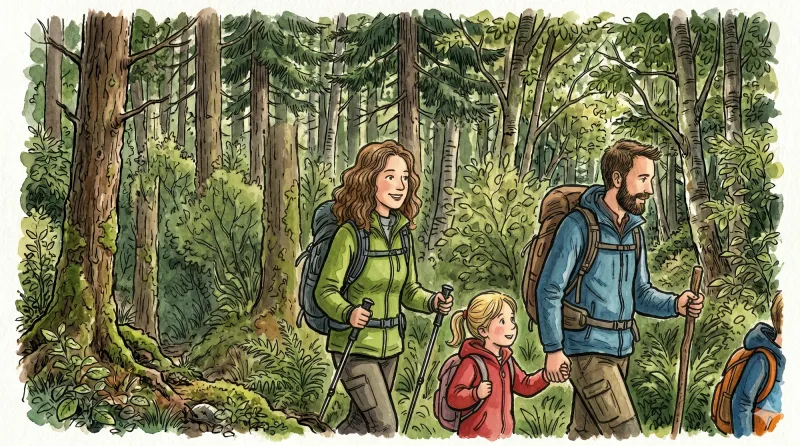
Entre Comté et Pays d'Issoire (circuit route n°17)
Discover this trail through the heart of Livradois-Forez.
Via Allier (V70), from Vichy to Langeac
The route follows the Allier for 455 km, from its confluence with the Loire near Nevers to Langogne in Lozère, close to its source. Auvergne’s cycle route begins near the celebrated Bec d’Allier, where the Allier meets the Loire and Via Allier meets the Loire à Vélo. It follows the river southwards through countless treasures to the upper Allier gorges, near the source hidden in the Cévennes mountains.
Explore Nearby
Complement your visit to Orléat by exploring these neighboring villages.
Bulhon
A contemplative destination where the architectural legacy of the Enlightenment meets the rugged, medieval roots of the Auvergne nobility.
Crevant-Laveine
A landscape of architectural "folies" and silent memorials, where Enlightenment-era grandeur meets the rural stillness of the Limagne plains.
Dorat
A high-plain settlement where the architectural legacy of the Barante dynasty meets a rare fortified sanctuary rising above the Dore valley.
Peschadoires
A riverfront destination where medieval fortifications meet the industrial echoes of a former inland port on the Dore.
Thiers
A vertical journey through France's blade-making capital, where medieval timber-frames hang over dramatic industrial gorges carved by the Durolle.