Illustration in progress
Rising to an elevation of nearly twelve hundred meters, the landscape of Saint-Jean-d’Aubrigoux is defined by a rugged, dispersed architecture of stone and timber that defies the traditional concentrated village model. The thick, obsidian-hued canopy of the surrounding forests frequently yields to high-altitude clearings where prehistoric megaliths stand as silent sentinels of the Neolithic era. Most striking among these is the Pierre des Fades, a dolmen of imposing granite that anchors local folklore in a physical, ancient reality. These massive stones, scattered across the high meadows, offer a tactile connection to the earliest inhabitants of the Plateau du Haut-Velay, their lichen-covered surfaces weathering the same biting mountain winds that have sculpted this terrain for millennia.
The village core reveals a layer of history that transcends the typical medieval narrative, particularly through its Romanesque church dedicated to Saint John the Baptist. Framing the entrance are two rare Carolingian columns dating back to the ninth or tenth century, their weathered capitals providing a stark, stoic elegance to the porch. A short distance to the south, a classified Roman milestone serves as a physical testament to the ancient thoroughfares that once integrated this high-altitude outpost into the wider imperial network. The interplay between the coarse grain of these pre-millennial pillars and the later fifteenth-century masonry creates a visual chronology of the region’s spiritual and civil endurance, manifesting in the very texture of the walls.
Beyond the ecclesiastical architecture, the commune’s identity is entwined with the elemental forces of its topography. The name “Aubrigoux” stems from the Old Occitan brac, evoking the bubbling or silty waters of the local stream that carves its way toward the Arzon. This connection to the land was so profound that during the fervor of the French Revolution, the community was stripped of its hagiographic title and known simply as Ous-Brigoux, an attempt to secularize a territory that had been documented since at least 938. To wander through the scattered hamlets today is to experience a landscape of quiet resistance, where the density of the woods and the severity of the climate have long dictated a unique, deliberate rhythm of existence.
Local profile
At a Glance
- Population
- 184
- Demonym
- —
- Altitude
- 880–1191 m
- Forest
- 44.3%
residents
local residents
lowest to highest
commune coverage
Did You Know?
“During the French Revolution, the village was renamed "Ous-Brigoux" to strip away its religious association with Saint Jean.”
Cultural Heritage
Protected historic monuments in Saint-Jean-d'Aubrigoux
Dolmen de la Pierre des Fades ou du Colombier
Saint-Jean-d'Aubrigoux
Recent Wildlife & Flora Log
Nature observations recorded within 5km of Saint-Jean-d'Aubrigoux.
Western Saddle Bush-cricket
Common Periwinkle
Lanius collurio Linnaeus, 1758
Common Linnet
Continental Robin
Milà reial
Black Redstart
Green-Winged Orchid
French-willow
Adder's Fern
Trails around Saint-Jean-d'Aubrigoux
Discover physical challenges and natural beauty in the immediate vicinity.
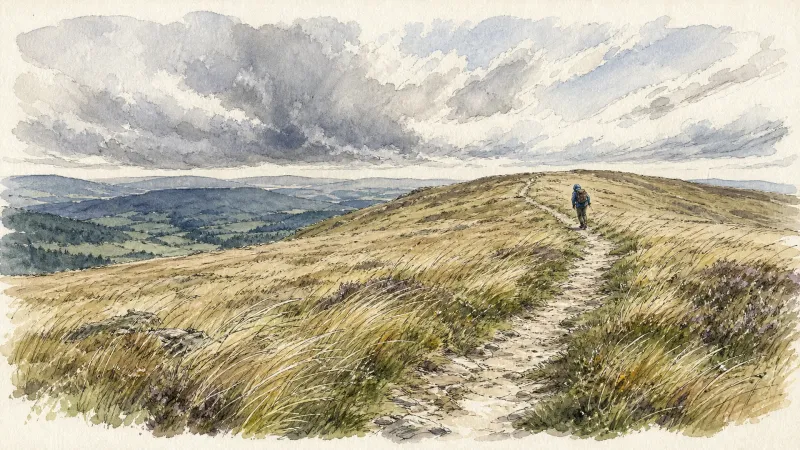
Dore Loop
The Livradois-Forez Regional Natural Park, a land of grassland and woodland, promises a memorable journey between valleys and ridges.
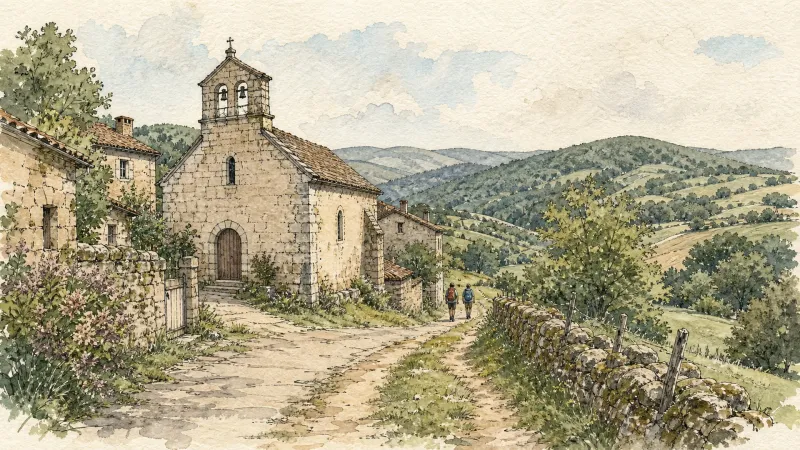
The Panoramas of Dore-l’Église
Set out on a panoramic walk to discover the Romanesque heritage of Dore-l’Église and beautiful, secluded hamlets with dry-stone houses.
Explore Nearby
Complement your visit to Saint-Jean-d'Aubrigoux by exploring these neighboring villages.
Bonneval
A high-altitude sanctuary where ancient feudal earthworks and vibrant 16th-century murals offer a profound glimpse into the medieval soul of the Velay.
Dore-l'Église
A high-altitude sanctuary where Romanesque architecture meets dark medieval lore, perfect for a contemplative afternoon detour through the southern reaches of the Livradois.
Jullianges
A high-altitude sanctuary on the Velay plateau where 14th-century ecclesiastical stone meets the unique spectacle of France’s loftiest equestrian racing circuit.
Malvières
A high-altitude sanctuary of ancient stone and dense woodland, where Romanesque architecture meets a vast botanical heritage on the Velay plateau.
Medeyrolles
A high-altitude sanctuary where the granite of the Forez meets a dense sea of spruce, offering a quiet, contemplative atmosphere for travelers seeking the raw textures of the Auvergne heights.
Saint-Victor-sur-Arlanc
A high-altitude threshold between the Forez and Livradois, centered on a 12th-century commandery of the Antonine monks.
Sauvessanges
A high-altitude granitic frontier where the Ance river flows through ancient tectonic fractures, offering a landscape of basaltic outcroppings and deep montane forests.