Illustration in progress
The Église Saint-Georges stands as a silent witness to nine centuries of spiritual devotion, its 12th-century stone walls guarding a rare treasure of interior artistry. Visitors who wander into the nave are met with a visual chronology of the Middle Ages, where mural paintings from the 13th, 15th, and 17th centuries layer upon one another like a palimpsest of faith. These pigments, survived through the ages, capture the evolving aesthetic of the Haute-Loire, offering a stark yet beautiful contrast to the rugged granite exterior that braves the high-altitude winds of the Velay.
Sweeping across a landscape that oscillates between 743 and 963 meters, the commune unfolds in a series of disparate hamlets, each anchored by the enduring presence of the forest. Over a third of the territory is claimed by dense timber, creating a rhythmic interplay between open agricultural plateaus and shadowed woodland corridors. This dispersed arrangement of stone dwellings reflects a traditional rurality where the environment dictates the architecture, favoring sturdy, low-slung structures designed to endure the mountain margin climate that defines this stretch of the regional park.
Tracing the lineage of this land reveals the ghosts of the Maison de Soleyrol, whose 14th-century presence still echoes through the eponymous hamlet. The archives speak of Pierre de Soleyrol, a preaching friar in Le Puy, and Pons de Soleyrol, who secured the lordship of Veyrines through a strategic union in 1383. This deep aristocratic history is etched into the very soil, surviving even the radical transformations of the late 18th century when the village briefly shed its hagiographic title for a secular identity. Today, a walk through the outlying paths toward the Chapelle Saint-François-Régis at Suc provides a sensory journey through these layers of noble heritage and peasant resilience.
Local profile
At a Glance
- Population
- 518
- Demonym
- —
- Altitude
- 743–963 m
- Forest
- 36.2%
residents
local residents
lowest to highest
commune coverage
Did You Know?
“During the French Revolution in 1793, the village was stripped of its saintly title and briefly renamed "George-l'Agricol" to emphasize its agrarian identity.”
Cultural Heritage
Protected historic monuments in Saint-Georges-Lagricol
Eglise
Saint-Georges-Lagricol
Recent Wildlife & Flora Log
Nature observations recorded within 5km of Saint-Georges-Lagricol.
Common dung beetle
Demetrias atricapillus (Linnaeus, 1758)
Spring Small Dung Beetle
Odiellus troguloides (Lucas, 1846)
Matt Felt Lichen
Dog-lichen
Lesser Featherwort
Orange Peel Fungus
Marpissa muscosa (Clerck, 1757)
Africanized honey bee
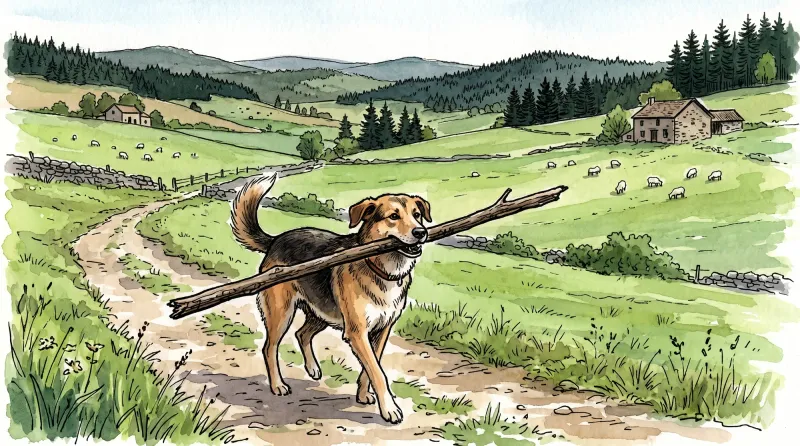
Trails around Saint-Georges-Lagricol
Discover physical challenges and natural beauty in the immediate vicinity.
Explore Nearby
Complement your visit to Saint-Georges-Lagricol by exploring these neighboring villages.
Beaune-sur-Arzon
An elevated highland retreat where ancient Gaulish water worship meets the enduring stone remnants of the Roman Voie Bolène.
Jullianges
A high-altitude sanctuary on the Velay plateau where 14th-century ecclesiastical stone meets the unique spectacle of France’s loftiest equestrian racing circuit.
Saint-Julien-d'Ance
A landscape forged by volcanic upheaval and the delicate threads of lace, offering a profound encounter with the geological and clerical history of the Velay.